

When a New Spider-Man Sends Everyone Back to the Old Ones
A cinema premiere turned into a streaming event for two decades of the franchise - and the biggest winner wasn't the studio behind it. Few fictional ...
A cinema premiere turned into a streaming event for two decades of the franchise - and the biggest winner wasn't the studio behind it.
Few fictional characters have been handed to a new actor as often, or as publicly, as Spider-Man. In a little over two decades audiences have watched three different Peter Parkers swing across live-action screens - Tobey Maguire, Andrew Garfield and Tom Holland - with an animated multiverse layered on top for good measure. Each reinvention arrives with its own fanbase, and none of the old ones ever really disappears; they just move to streaming and wait. That waiting catalogue is what makes a Spider-Man premiere worth watching for anyone who studies viewing behaviour, because a new film in cinemas has a habit of dragging the entire history of the character back into view.
That is exactly what the data showed across 36 markets analyzed when Spider-Man: Brand New Day, the latest Holland-led instalment, opened on July 31, 2026.
A premiere you could see on streaming
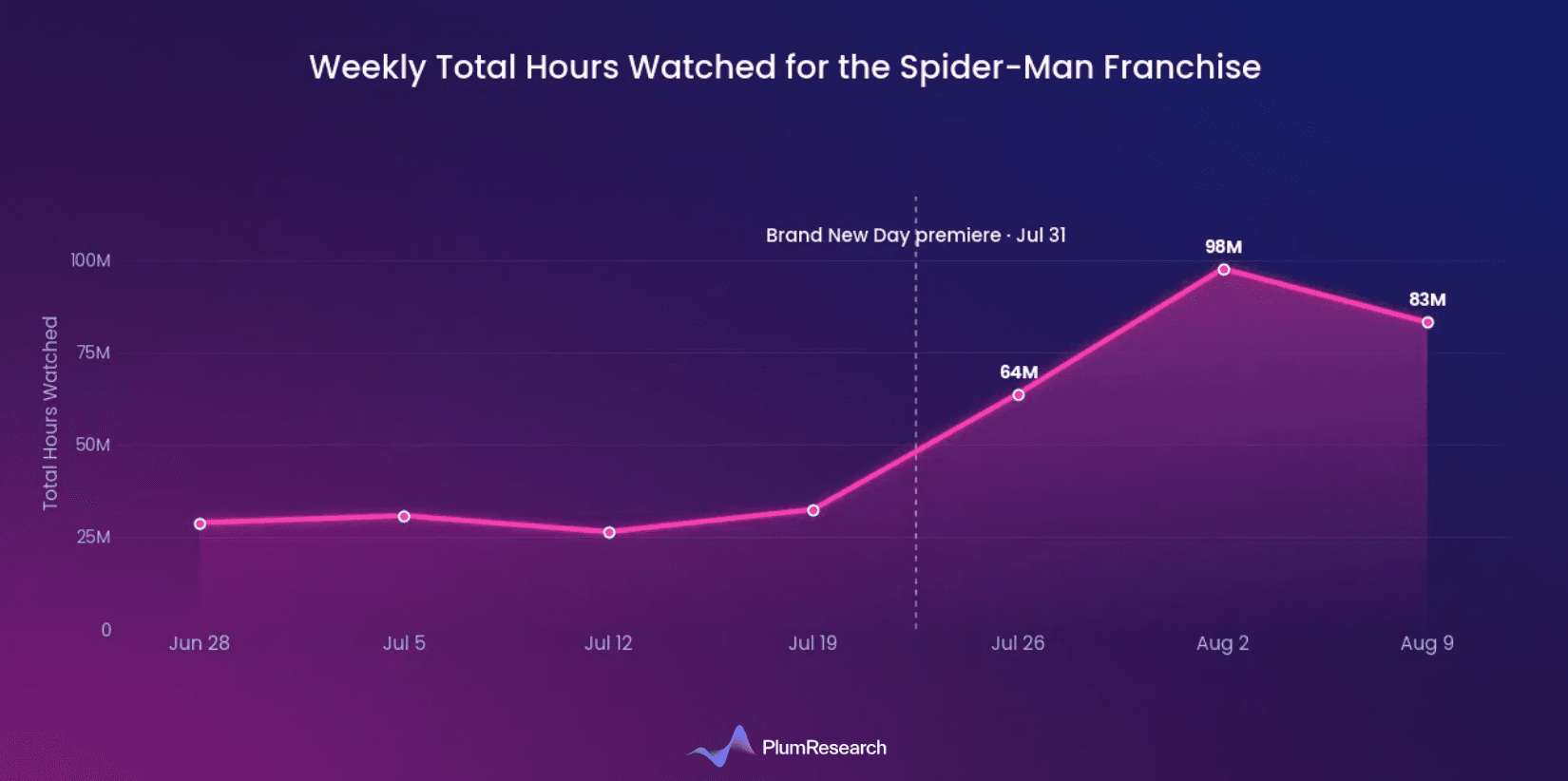
For most of the summer the franchise ticked along quietly. Between late June and mid-July the back-catalogue drew a steady 26 to 32 million hours a week across the major platforms, the kind of unremarkable baseline a two-decade-old franchise settles into. Then the film arrived, and the numbers stopped being unremarkable. In the first full week after release, weekly viewing roughly tripled to almost 98 million hours, with unique viewers climbing to around 48 million.
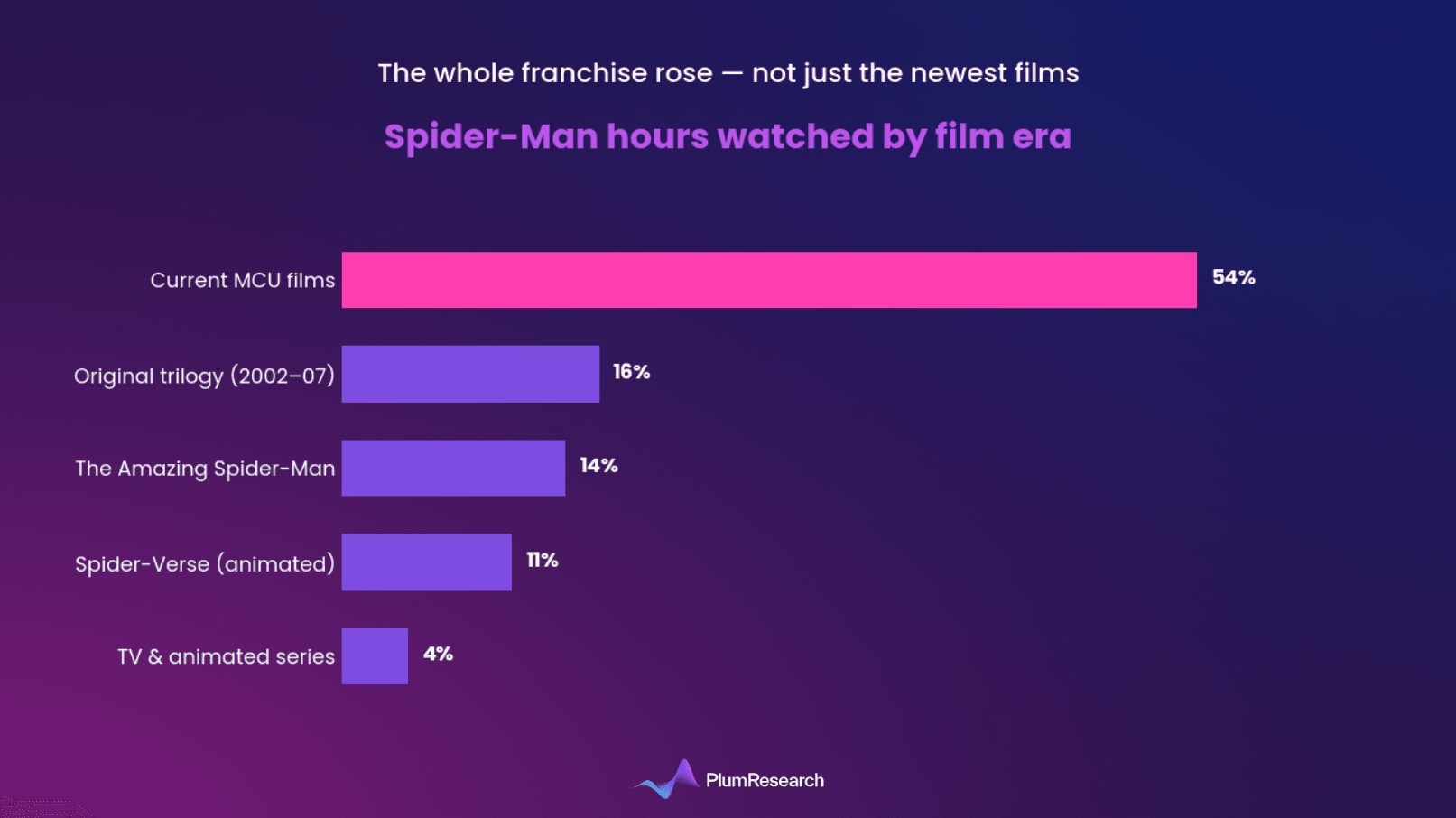
What stands out in our data is that the surge didn't confine itself to the newest films. The lift was spread right across the character's history. The current Holland run did the heaviest lifting, but it was far from the whole story: Sam Raimi's 2002 original, Garfield's Amazing films and the animated Spider-Verse together accounted for nearly half of the hours watched. A premiere, in other words, doesn't just sell its own sequel. It reminds people they have twenty years of Spider-Man sitting one click away.
The windfall went to someone else's platform
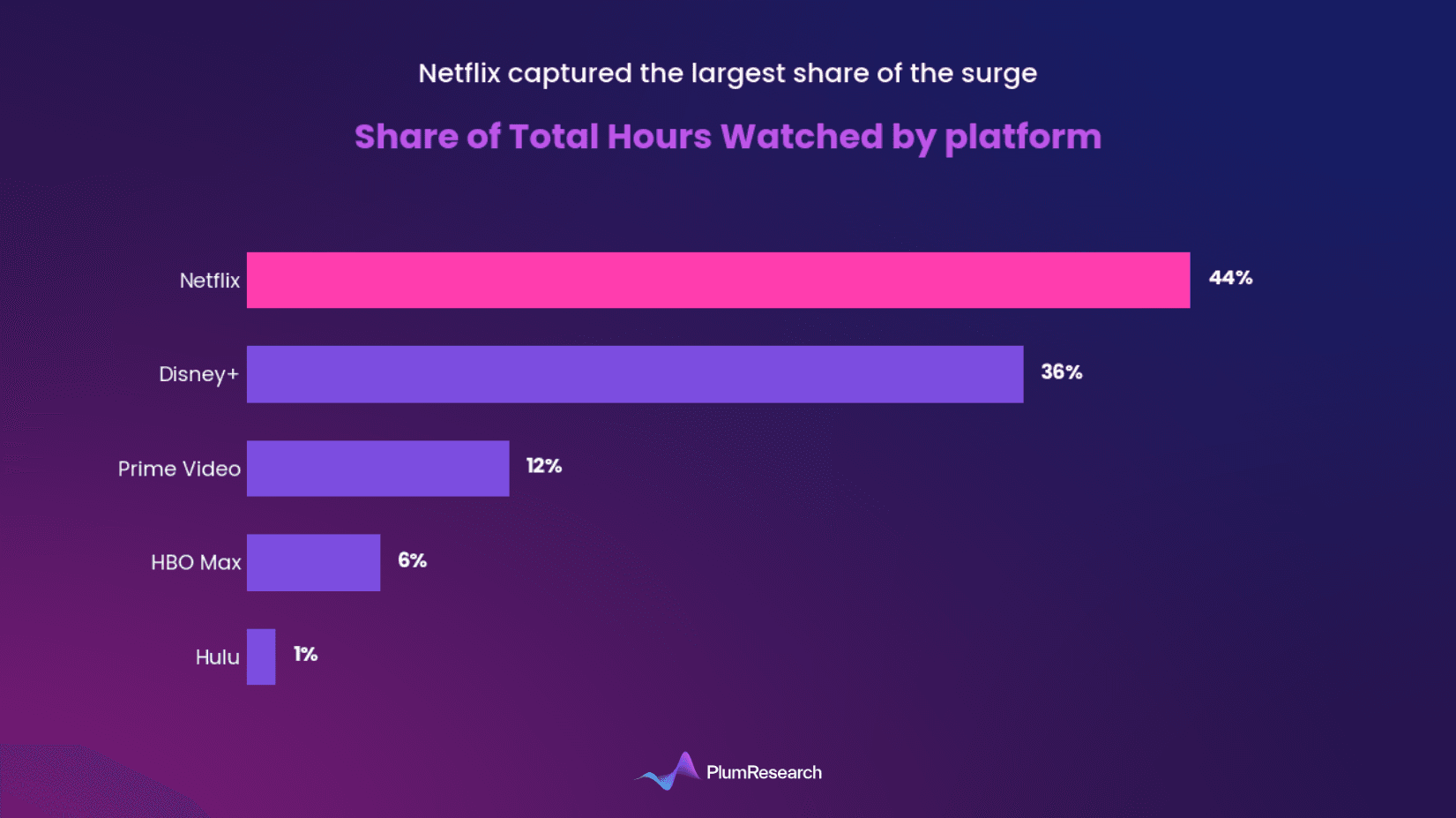
The more revealing question is where all that watching actually landed, and the answer is a little awkward for the people who made the film. Netflix, which neither produced nor released Brand New Day, took the single largest share of the surge: 44% of hours watched, comfortably ahead of Disney+ on 36%, with Prime Video, HBO Max and Hulu dividing what was left.
None of this is an accident of the box office; it's a quirk of how Spider-Man is licensed. Sony owns the character on film - Marvel and Disney merely co-produce the Holland pictures - and Sony's catalogue is currently spread across services: under its output deal, recent Sony releases go to Netflix first before moving to Disney+ later, while parts of the older library already sit on Disney+ from an earlier agreement. The result is visible in the numbers. Netflix's share was carried by Homecoming and Far From Home, while Disney+ leaned almost entirely on No Way Home. Brand New Day itself, still playing in cinemas, was nowhere on streaming at all. Every hour of this surge was spent on films that already existed; the new one simply set them off.
What the industry keeps relearning
A theatrical release is no longer just a theatrical release. It's a demand event whose after-effects show up on balance sheets the studio doesn't control. A new Spider-Man film in cinemas didn't just sell tickets to a new Spider-Man film; it pulled two decades of the character back onto streaming, and handed the largest share of that attention to Netflix - a platform that neither produced nor released the film, even if it holds the first streaming window that comes next.
And that is the part worth keeping an eye on. Under Sony's output deal, Brand New Day lands on Netflix once its cinema and home-entertainment windows close, most likely around the turn of the year. What we've measured so far is the catalogue effect on its own - the older films warming up while the new one is still in cinemas. Whether its streaming debut adds a second wave, or simply absorbs demand the back-catalogue has already been soaking up, is an open question, and one worth watching once the film crosses over.
Either way, the premiere has already done what premieres increasingly do: fill the cinemas for a month, and quietly refill the catalogue behind them.