

What Happens After Reactivation? Understanding the Different Ways Titles Bring Viewers Back
Which titles bring inactive viewers back - and what happens after they return?
What does a “successful” reactivation look like?
Looking at the ranking of the most-watched titles on streaming platforms is only the first step in understanding content success. Streaming services are balancing several priorities at once: engaging existing subscribers, attracting new ones, and preventing churn. A key part of that equation is not only bringing users back, but understanding what happens once they return.
Some subscribers are heavy users, watching every day, while others engage with a platform much less frequently. At some point, however, even active subscribers can stop watching altogether. They may remain subscribed but become inactive for weeks or months, until a particular title gives them a reason to come back.
This is where reactivation becomes an important lens. PlumResearch’s Reactivation metric identifies titles that bring users back to a platform after a period of inactivity. But rather than stopping at identifying the titles that drive the most reactivation, we wanted to look at what happens next: does watching a particular title lead to sustained engagement, deeper viewing, or exploration of the wider catalog?
We analyzed users reactivated by titles in Q2 2026 on Disney+, HBO Max, Hulu, Netflix, Prime Video, and Peacock in the United States, focusing on their behavior after returning to the platform. The results based on the top 200 titles that brought inactive users back suggest that reactivation has several dimensions: scale, retention, depth and breadth.
The titles bringing the most users back
The most straightforward way to look at reactivation is to ask which titles brought the largest number of inactive users back to the platform. The table below shows the ten titles that brought back the largest number of users in Q2 2026, who had been inactive for at least 30 days before watching the title.
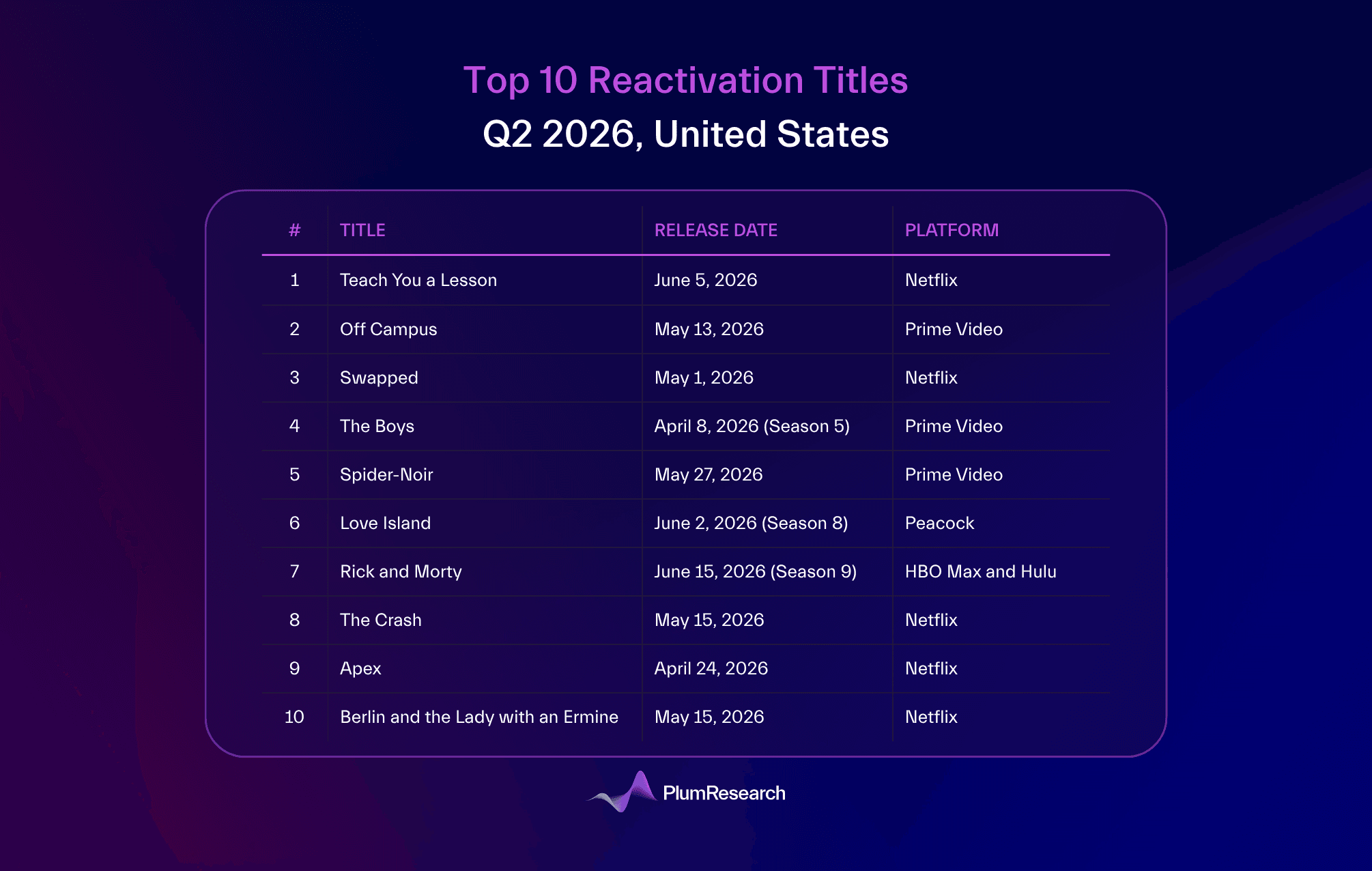
The Q2 2026 ranking is dominated by recent releases and returning franchises, including Teach You a Lesson, Off Campus, Swapped, The Boys and Spider-Noir.
The pattern is clear: new releases and new seasons remain powerful reactivation triggers. They give both active and inactive subscribers a fresh reason to open the platform, making major launches an important part of a streaming service's strategy.
But reach is only the first measure of success. A title can bring thousands of inactive users back without necessarily turning those users into active viewers again.
That raises a more interesting question: what happens after the reactivation?
Reactivation doesn’t always mean sustained engagement
Once a user returns, the next question is whether they remain active. To explore this, we looked at two measures: retention rate and one-hit-wonder rate. Retention measures the share of viewers who become active again within 7 or 30 days after watching the reactivation title, while the one-hit-wonder metric captures viewers who watch that title and then disappear again for the remainder of the 30-day period.
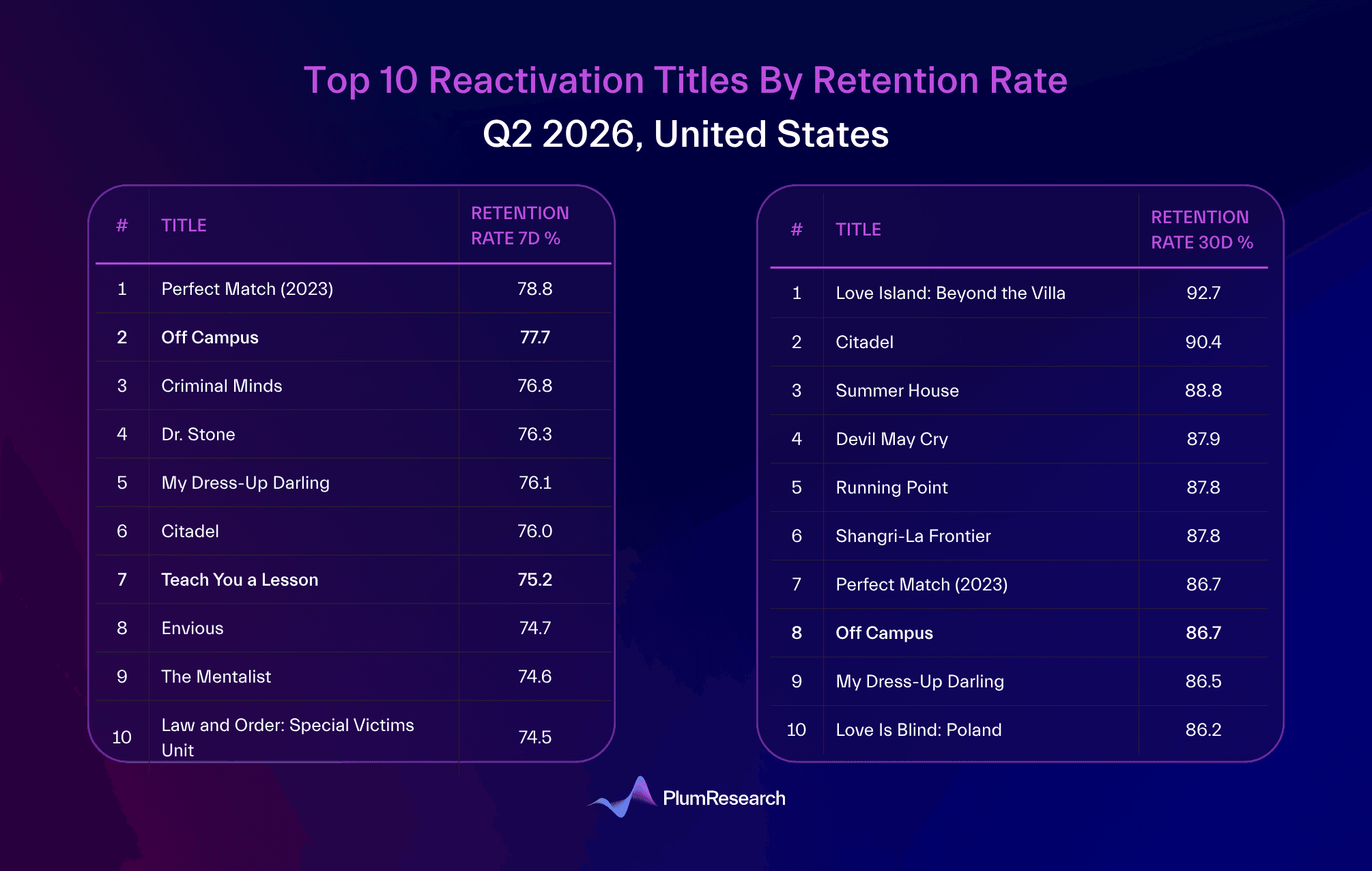
When the retention rankings are compared with the ranking of titles by the number of reactivated users, only Off Campus and Teach You a Lesson appear in both. This suggests that the titles capable of generating the greatest volume of reactivation are not necessarily the same titles associated with the strongest subsequent retention.
The one-hit-wonder data makes this distinction even more visible.
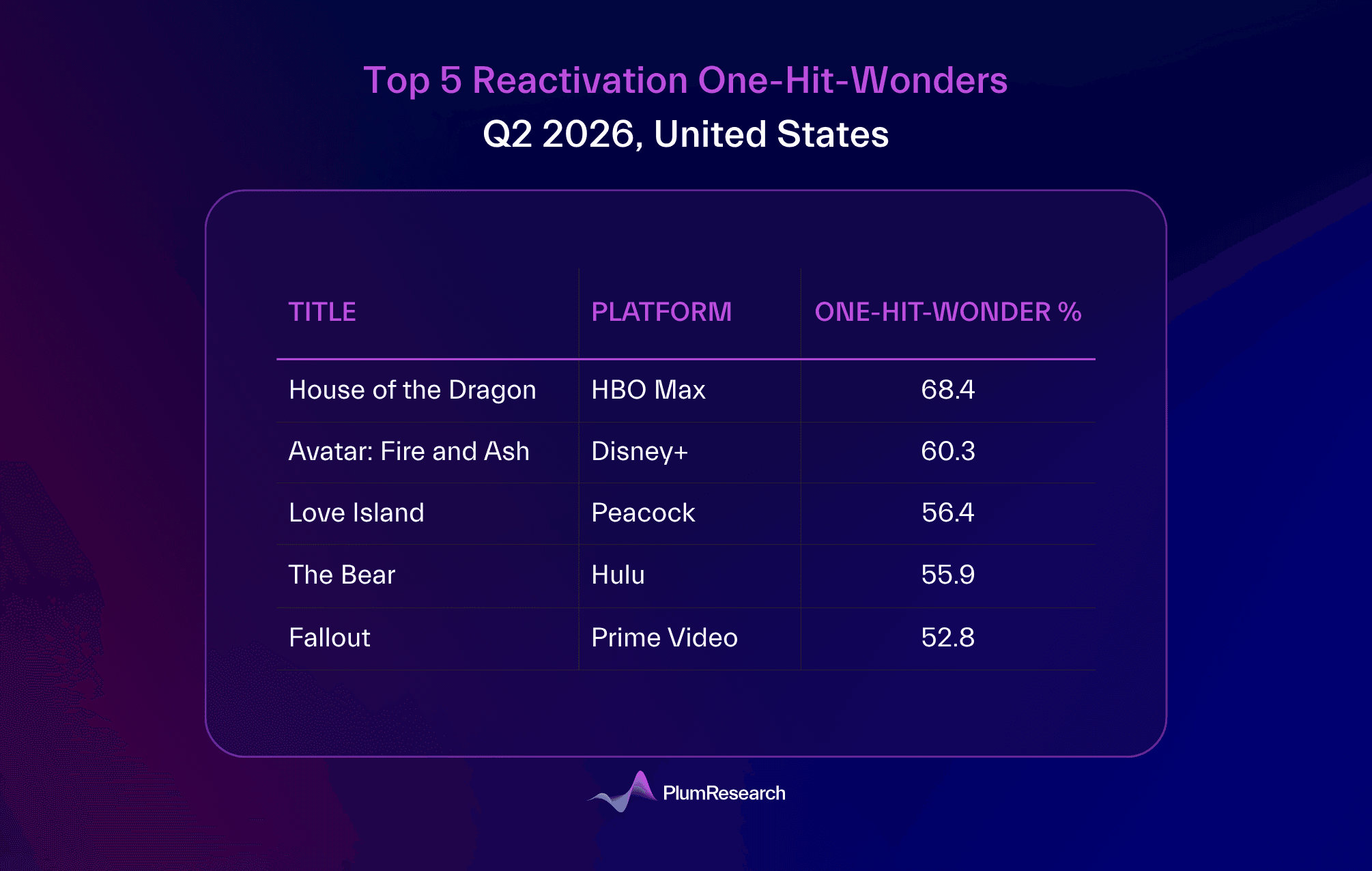
House of the Dragon has the highest one-hit-wonder rate at 68.35%, followed by Avatar: Fire and Ash at 60.34%, Love Island at 56.43% and The Bear at 55.88%.
Interestingly, these are not obscure titles struggling to find an audience. They are major releases with established fanbases. Their audiences may have returned for a very specific reason: a new season, a continuation of a franchise, or a highly anticipated release. Once they have watched the content they were waiting for, there may be little incentive to explore further.
This creates an important distinction: a title can be highly successful at reactivating its audience while being much less successful at re-engaging those users with the platform as a whole.
What happens after the one hit?
To understand whether reactivation translates into broader engagement, we looked at four additional measures over the 30 days following reactivation: active days, viewing sessions, subsequent titles watched and subsequent genres watched. The tables below show titles with the lowest score in each of these categories.
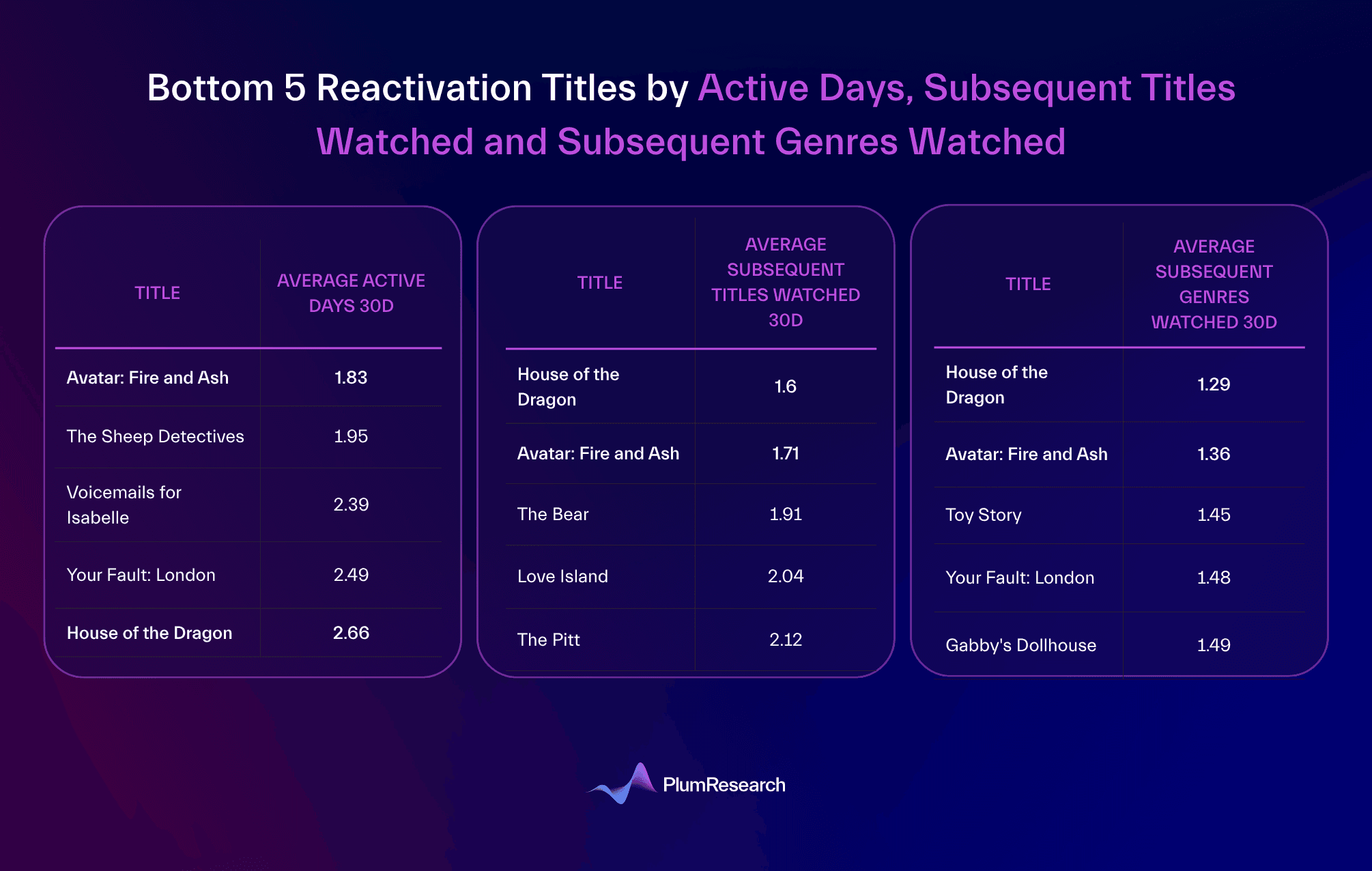
The pattern becomes particularly clear at the lower end. Avatar: Fire and Ash has the lowest average number of active days at 1.83, while House of the Dragon records only 2.66. House of the Dragon also has the lowest average number of subsequent titles watched, at 1.60, while Avatar: Fire and Ash follows at 1.71. The same two titles sit at the bottom of the subsequent-genres measure, at 1.29 and 1.36 respectively.
The overlap is telling. These titles combine high one-hit-wonder behavior with shallow post-reactivation engagement.
In other words, their viewers came back, but largely for the title itself, rather than to resume broader viewing activity on the platform.
What keeps users active?
At the other end of the spectrum are titles associated with much deeper engagement after reactivation.
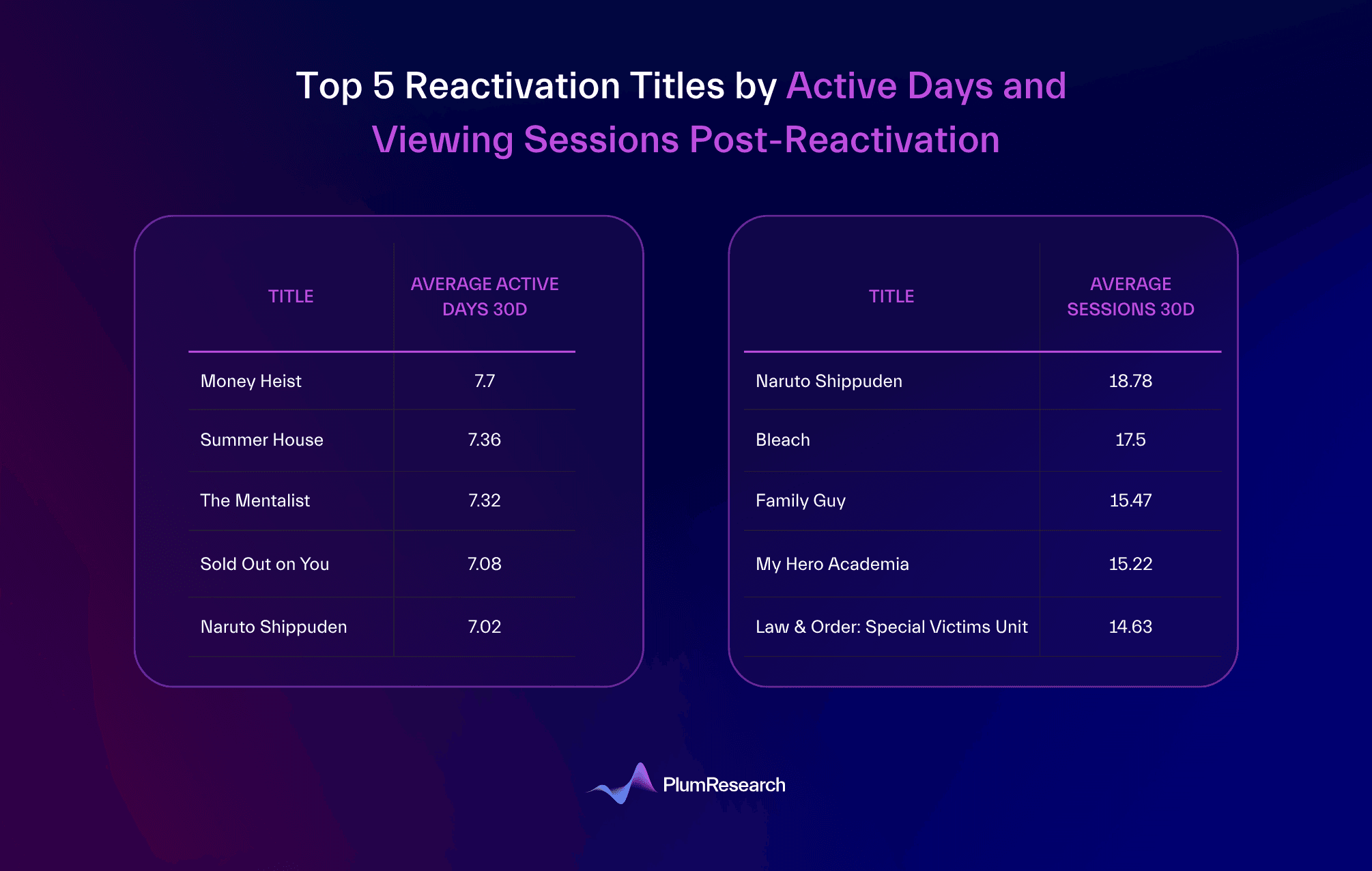
Money Heist, Summer House, The Mentalist, Sold Out on You and Naruto Shippuden lead the active-days ranking, while Naruto Shippuden, Bleach, Family Guy, My Hero Academia and Law & Order: Special Victims Unit lead in viewing sessions.
A common characteristic stands out: content runway.
These are titles with multiple episodes and, in many cases, substantial catalogs that give viewers an immediate reason to continue watching. The same pattern is visible across long-running dramas and procedurals, adult animation and anime.
The implication is not simply that episodic content is inherently better at reactivation. Rather, these titles appear to offer something that a single release or highly anticipated event may not: a clear next viewing opportunity.
Reactivation can therefore become the beginning of a viewing habit rather than the end of a single content mission.
Reactivation can also drive discovery
Sustained engagement, however, is not only about watching more frequently. Another form of success is whether a reactivated viewer starts exploring the wider catalog.
Some titles stand out for the number of subsequent titles and genres watched in the 30 days after reactivation
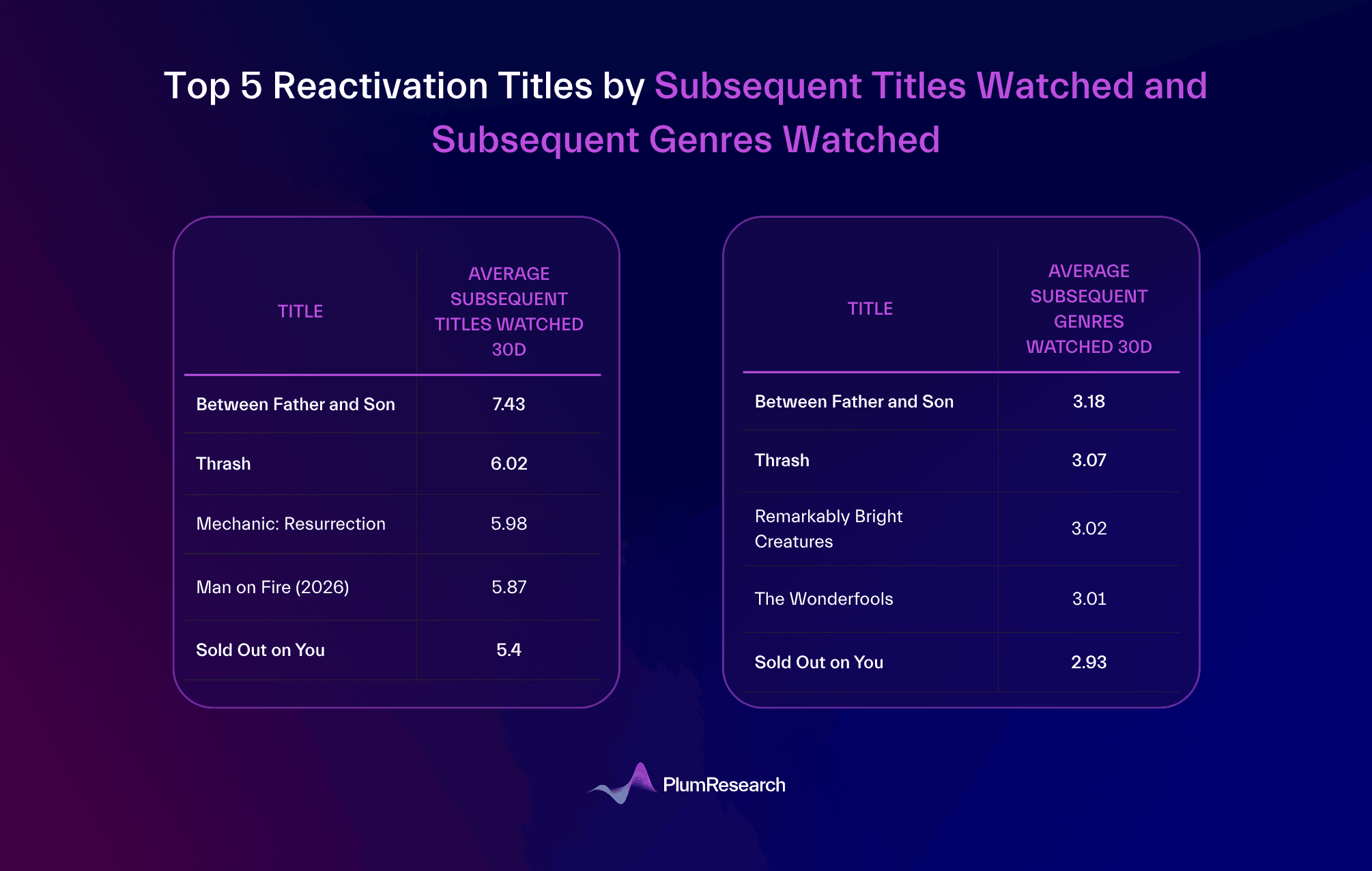
Between Father and Son leads both measures, with an average of 7.43 subsequent titles and 3.18 subsequent genres. Thrash and Sold Out on You also appear near the top of both rankings.
This suggests a different type of reactivation: the gateway title.
The user returns because of one piece of content, but that viewing becomes a starting point for further exploration. Whether the original title wasn't quite what they expected, prompted them to keep browsing, or simply reminded them of the wider catalog, the result is the same: the reactivation extends beyond the original title.
For streaming platforms, this type of behavior is particularly interesting because it connects reactivation with content discovery rather than simply repeat viewing.
So, are there different types of reactivation?
Taken together, the Q2 data suggests that reactivation is not a single behavior. A title can succeed by bringing a large audience back, by turning that return into repeated viewing, or by encouraging users to explore the wider catalog.
This points to four distinct roles:
The key takeaway is that there is no single definition of a successful reactivation title. Looking only at how many users a title brings back can miss what may be the most important part of the story: what those users do afterward.
For streaming platforms, the opportunity is therefore not simply to find the titles that can bring inactive users back. It is to understand which content can turn that moment of return into sustained engagement, deeper viewing and continued discovery across the platform.