

The Lowest Peak, the Biggest Pull: What Lizzie Borden Did for Netflix's Anthology
How Lizzie Borden sent viewers back to Netflix’s earlier Monster seasons
Monster: The Lizzie Borden Story, the fourth season of Netflix's true-crime anthology, had the lowest peak of the four. Yet it added more viewing to the earlier seasons than any launch before it. In its first six weeks on Netflix, the three earlier seasons gained about 33 million extra hours watched, equal to 13% of Lizzie Borden's own viewing.
The flow went both ways. More than seven in ten Lizzie Borden viewers already had watched the franchise. Of those who discovered it through Lizzie Borden, more than four in ten went on to watch an earlier season.
A lower peak
Its opening days were level with the two previous seasons: Netflix's official Top 10 gave it 12.1 million views for September 17-20, against 12.2 million for Ed Gein and 12.3 million for the Menendez season in their opening days. The gap opened in its first full week (September 21-27), when Lizzie Borden peaked at 94.9 million hours watched worldwide, 36% below Ed Gein's peak a year earlier. Over its first six weeks it was watched for 257 million hours, 31% less than Ed Gein over the same stretch. Like Ed Gein, it faded quickly: in the week after its peak it was at less than half of that level, while the Dahmer and Menendez seasons were still above 70%.
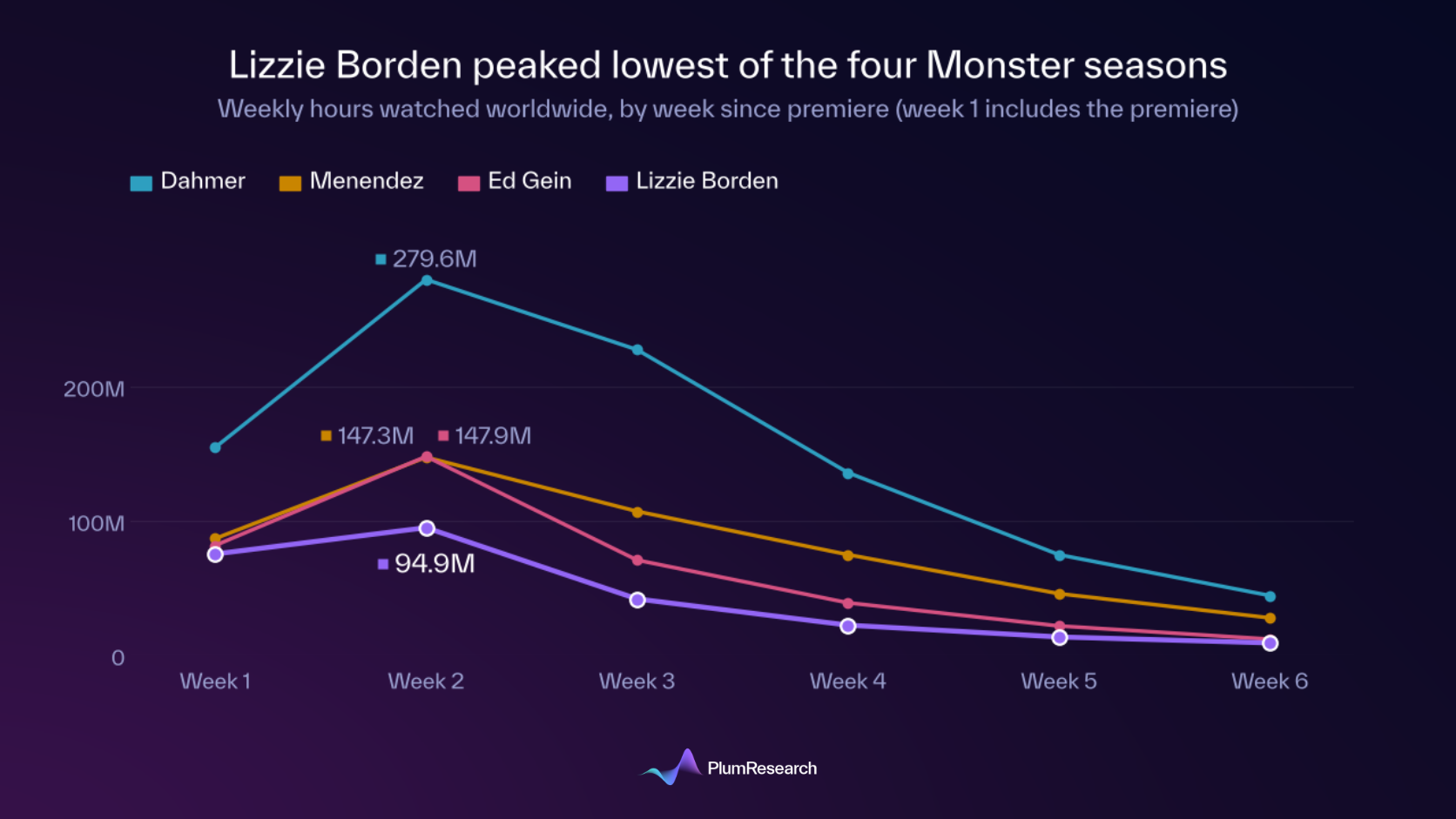
Showlabs data covers 51 Netflix markets; the worldwide figures presented are the totals across them. Weeks run Monday to Sunday, and the first of the six weeks is the one that includes the premiere.
The biggest lift for the back catalogue
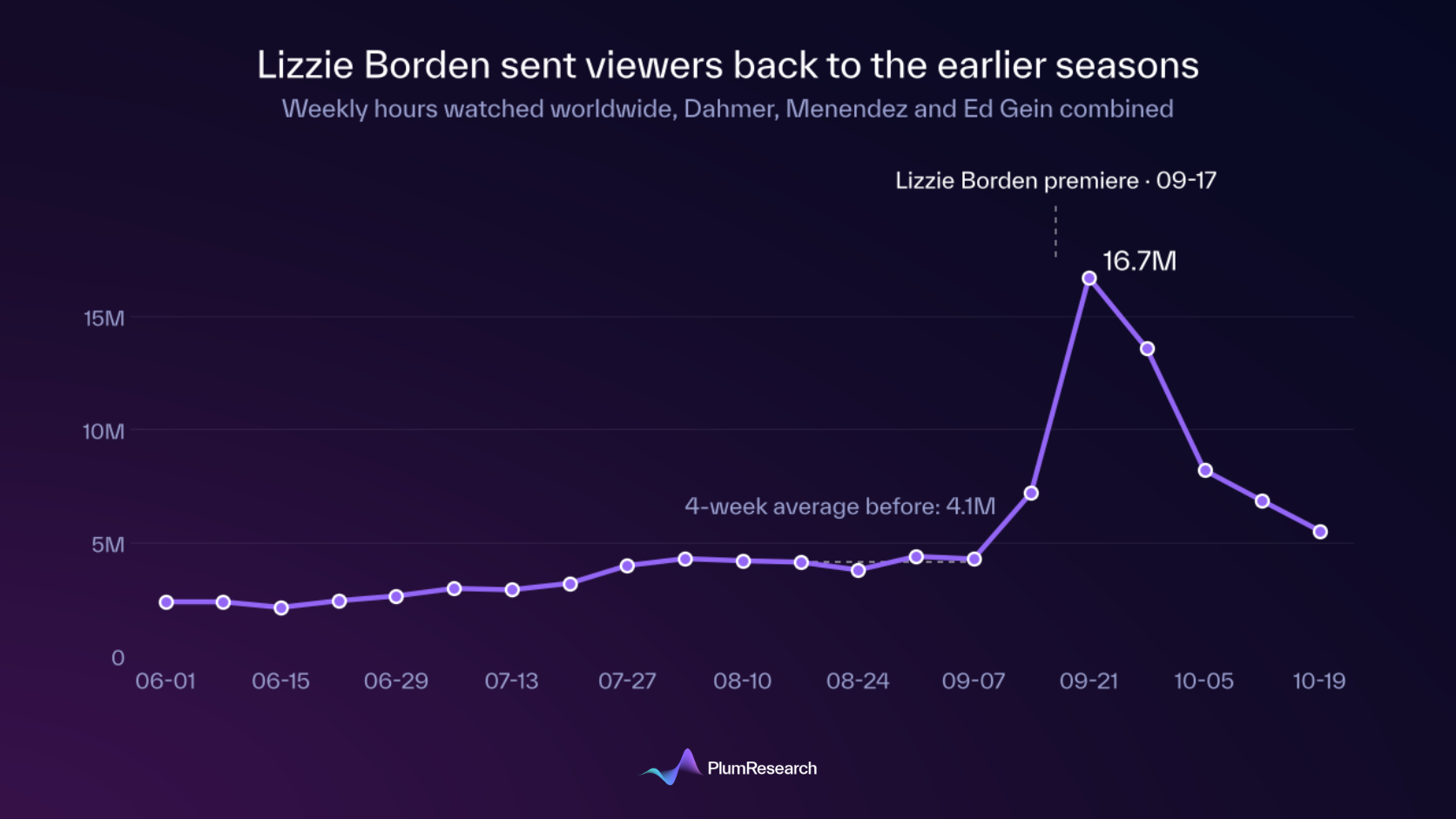
In the four weeks before the premiere, the three earlier seasons were watched for 4.1 million hours a week combined. In Lizzie Borden's first full week this rose to 16.7 million, four times as much. Dahmer rose to 3.6 times its earlier level, Ed Gein to 4.1 times and the Menendez season to 4.5 times. In the sixth week, Dahmer and the Menendez season were still watched 1.5 and 2 times as much as before the premiere.
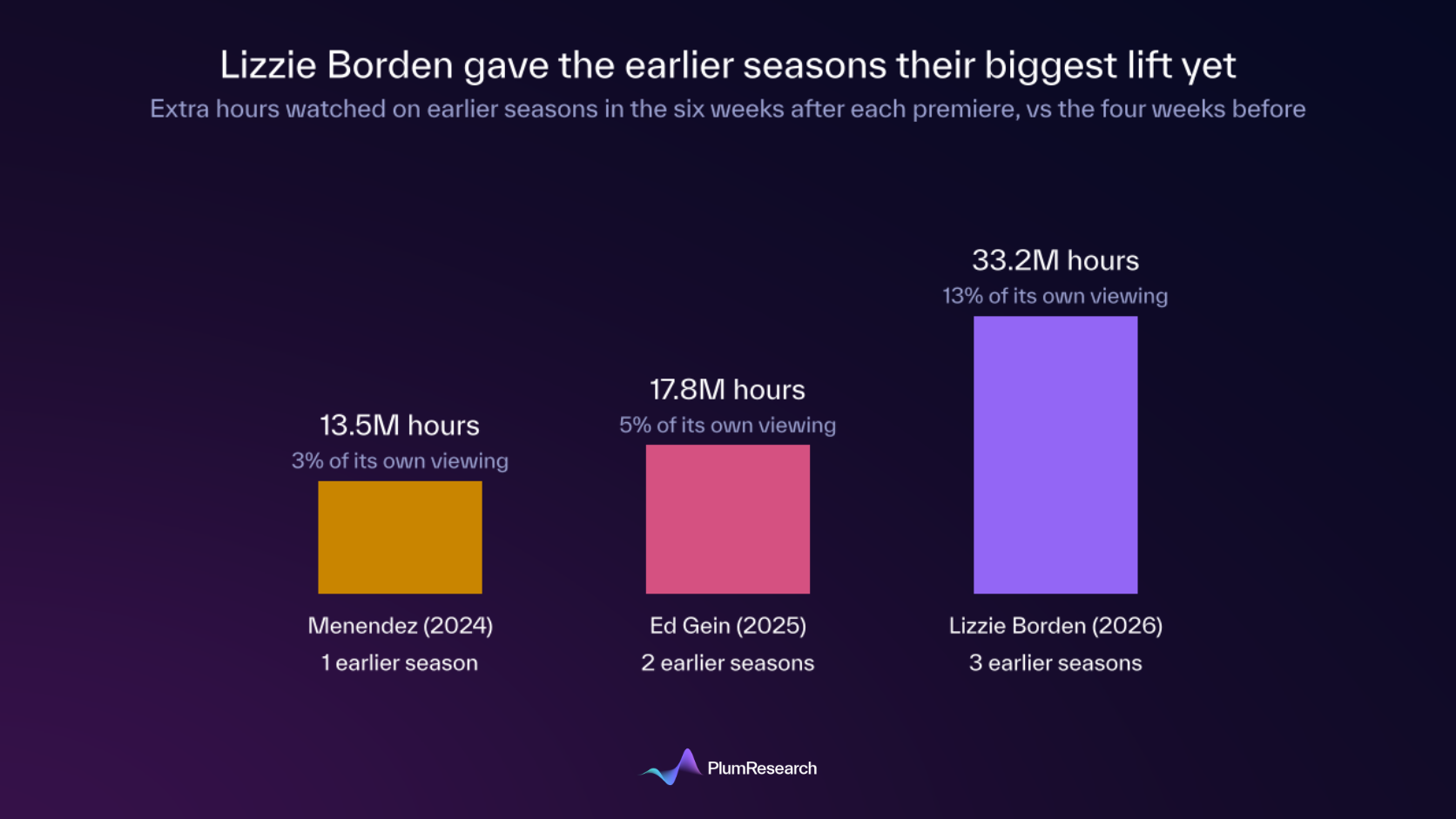
Both earlier launches also lifted the seasons before them, but neither added as many hours. Over six weeks, the older seasons gained about 33 million extra hours with Lizzie Borden, against 18 million when Ed Gein premiered and 13.5 million with the Menendez season. Part of that comes from having three seasons to send viewers back to rather than two or one. Relative to its own size, the effect was larger still: the extra hours equaled 13% of Lizzie Borden's own viewing, against 5% for Ed Gein and 3% for the Menendez season.
Fans first, and newcomers who kept going
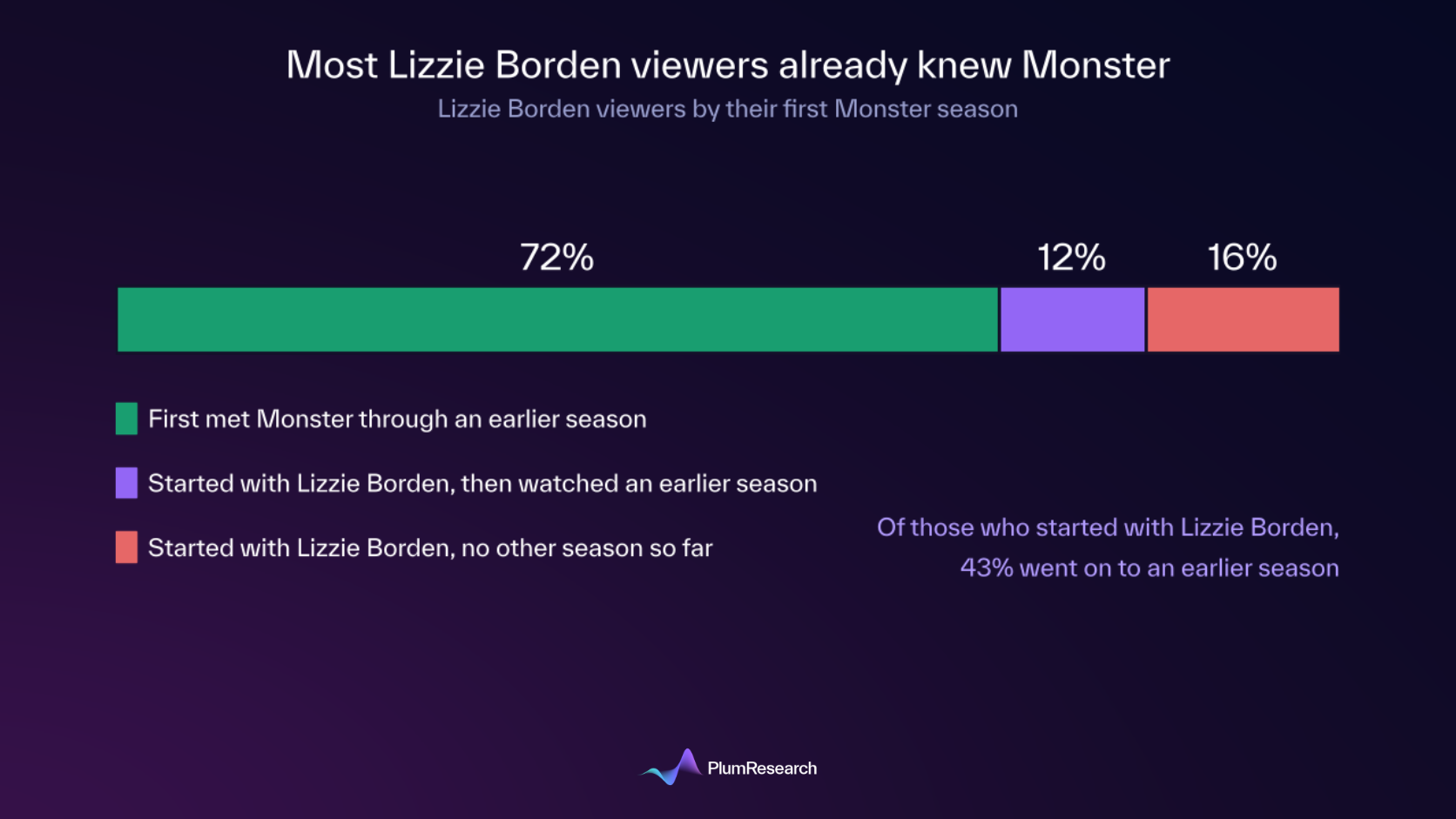
Lizzie Borden's audience came mostly from the franchise: 72% of its viewers had first met Monster through an earlier season. For the other 28%, Lizzie Borden was their first Monster story, and 43% of them went on to watch at least one earlier season, 12% of all Lizzie Borden viewers. So far, only 16% have watched no other Monster season.
Beyond crime and thrillers, the favourite genres of Lizzie Borden viewers are comedy and romance.
Hard to start, hard to leave
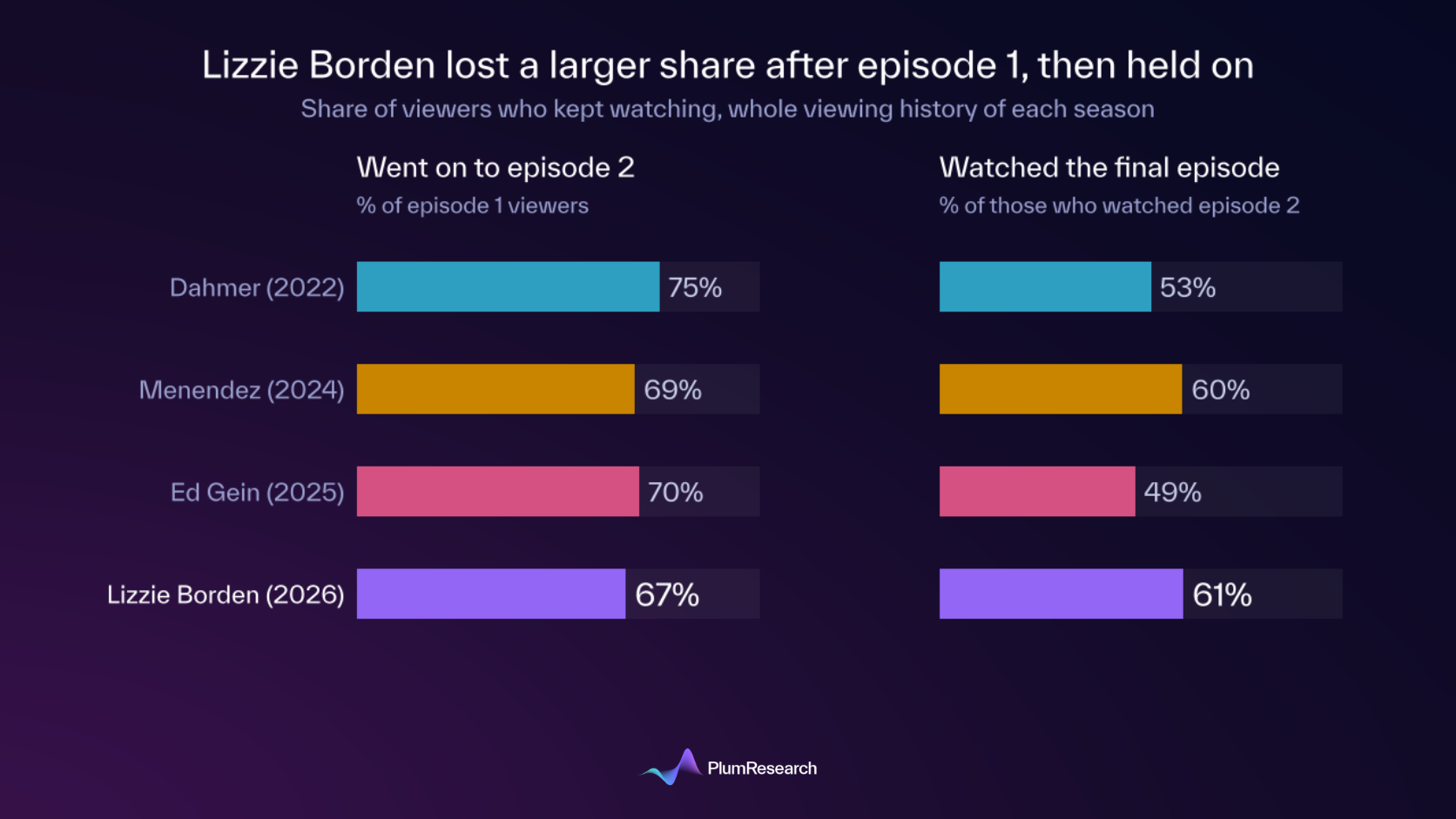
Lizzie Borden lost a larger share of its viewers after the first episode than any earlier season: 67% of those who watched episode 1 went on to episode 2, against 69% to 75% for the others. But most of those who stayed went all the way. Of the viewers who reached episode 2, 61% watched the finale, on a par with the Menendez season and ahead of Dahmer and Ed Gein. In under six weeks, 40% of those who started Lizzie Borden reached its last episode, already about the same share as Dahmer (40%) and the Menendez season (42%) over their whole time on Netflix, and more than Ed Gein (34%).
What it means
A new season of an anthology is judged by its own launch, but its value carries across the whole franchise. Lizzie Borden had the lowest peak of any Monster season, yet most of the viewers who got past its first episode stayed to the end. It also worked as a door into the series: more than four in ten of the viewers who came in through it went on to an earlier season; adding more viewing to the earlier stories than any launch before it.