

The Clash of Release Models: Binge-Watching vs. Weekly Drops
Prime Video's binge-drops against HBO's weekly releases. (March 2026)
In March 2026, Showlabs data for the US market exposed the mathematical truth about how release schedules dictate engagement and binge-watching metrics.
Anatomy of Consumption: Binge vs. Weekly Drop
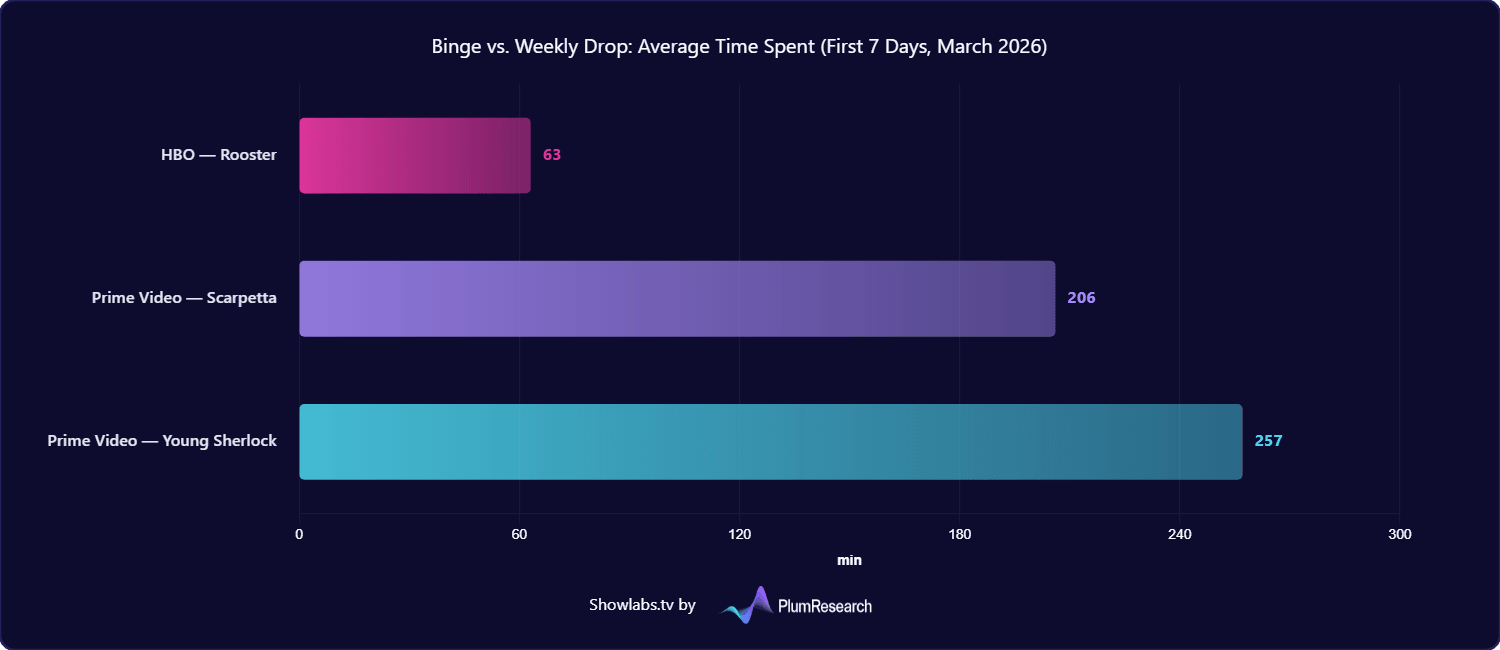
The March lineup is a battle between instant gratification and building a weekly habit. Prime Video made the decision to drop the entire 8-episode seasons of its hits all at once: Young Sherlock debuted on March 4, and Scarpetta on March 11. Conversely, HBO opted to drip-feed Rooster, releasing episodes on March 8, 15, and 22. This distribution decision drastically skews the key Average Time Spent (ATS) metric in the crucial first 7 days window (7D Post-Release):
The low time engagement for Rooster is not an anomaly – it is a physical limit resulting from the availability of only a single episode in the analyzed window.
HBO's Pulsing Engagement vs. Amazon's Avalanche
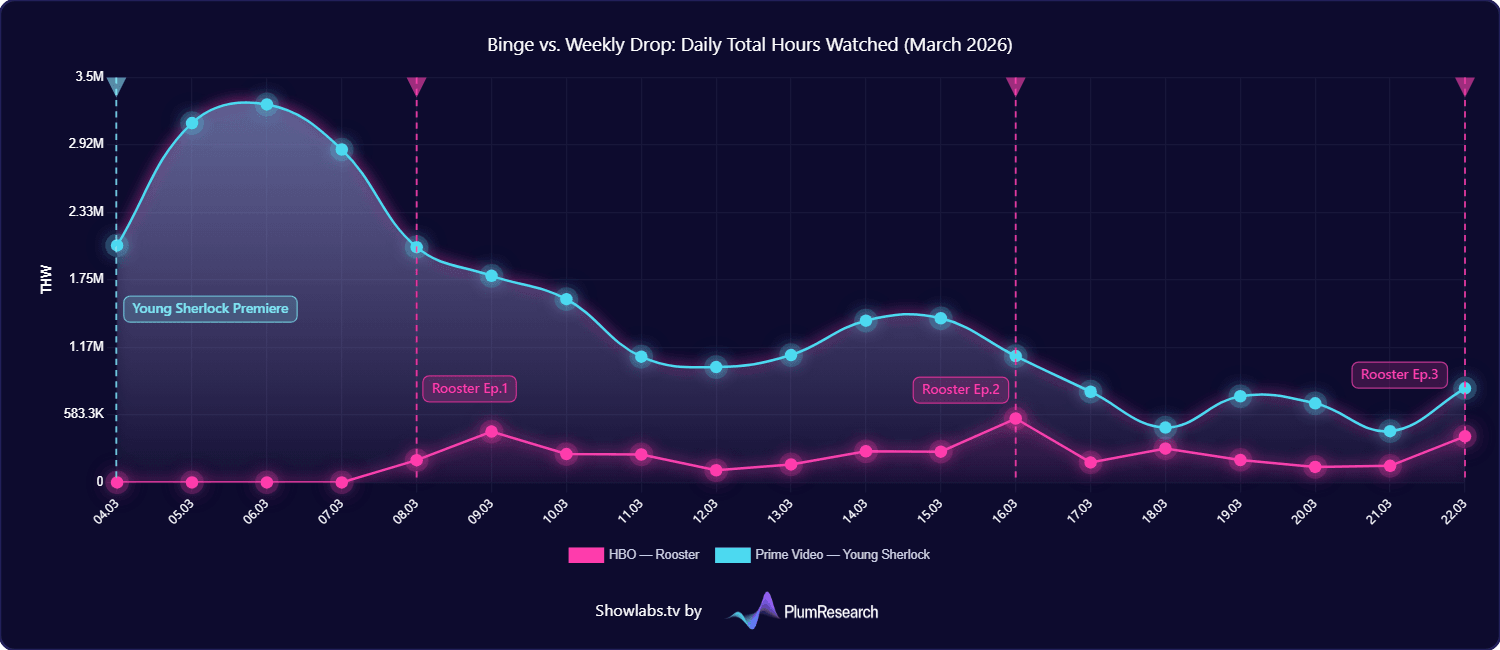
Instead of speculating about platform intentions, one simply needs to look at the daily distribution of Total Hours Watched (THW). The chart for Rooster is a classic cardiogram. We can see clear viewership peaks correlated with subsequent episodes: March 8 (192k THW, release day), March 16 (552k THW, the day after the second episode's release), and March 22 (398k THW, third episode).
Meanwhile, Prime Video titles are a classic avalanche. Young Sherlock cemented 2 million viewing hours on its release day (March 4), only to reach an absolute peak of 3.2 million hours just two days later (March 6), after which it began to naturally and slowly decline.
This model successfully activates the Binge Watching metric: in the first 7 days, over 67% of Young Sherlock viewers and 68% of Scarpetta viewers watched at least two episodes in a single session. Even more striking is their deep binge capability—over 30% of the audience for both titles consumed at least four episodes in one sitting (30.26% for Young Sherlock and 33.61% for Scarpetta), an exceptionally strong result for platform retention.
Subscriber Reactivation: The Striking Power
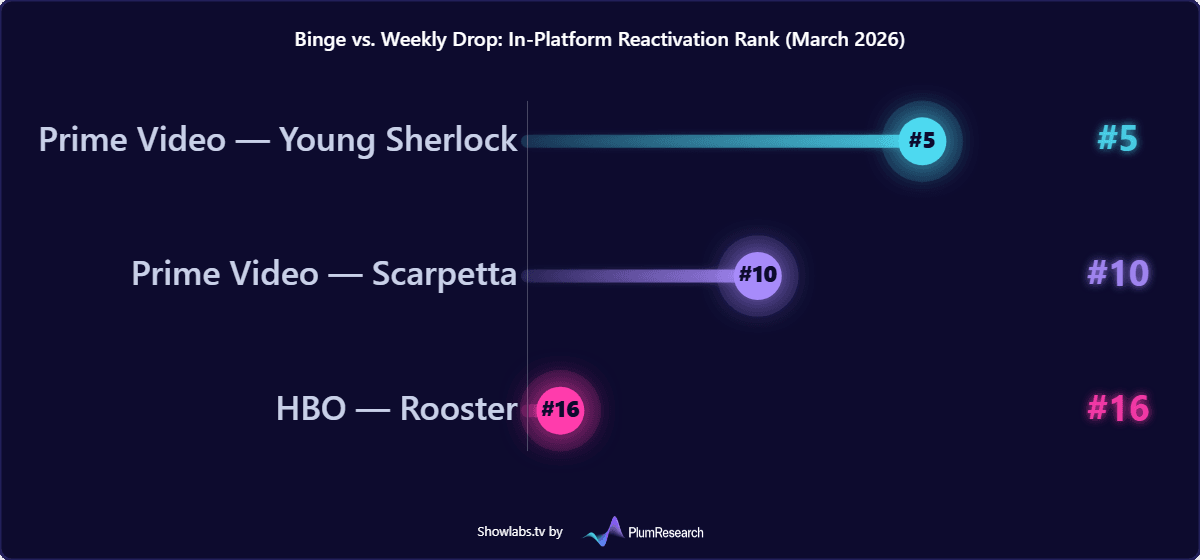
A crucial test for any new title is its Reactivation Rank - the ability to awaken "dormant" accounts. The data proves that in March, dropping the entire season worked much more effectively. Another key metric in evaluating a new title is its Reactivation Rank, which measures its effectiveness in re-engaging inactive accounts. Data from March indicates that releasing an entire season at once generated a stronger immediate reactivation response. Young Sherlock achieved the 5th position in the reactivation ranking, while Scarpetta secured the 10th spot. Rooster, operating on a weekly release schedule, placed 16th. These figures indicate that a full-season drop currently provides a stronger initial catalyst for dormant subscribers to return to a platform compared to a single-episode premiere.
While the initial 7-day metrics clearly favor the binge-release model, a comprehensive evaluation of these distribution strategies requires a longer time horizon. Because Rooster operates on a weekly release schedule, its true performance capacity cannot be definitively measured until the entire season is available on the platform. A complete long-term analysis—assessing cumulative Total Hours Watched and overall viewer retention—will be necessary to determine if HBO's strategy of sustained, week-over-week engagement can ultimately match the front-loaded metrics generated by Prime Video's bulk releases.