

Case Study: Goal or goooooool? An analysis of the FIFA World Cup group stage broadcasts on Telemundo via Peacock shows that sports goes beyond both language and device barriers (July 2026)
World Cup viewing on Peacock crosses language and device barriers
The best evidence that the World Cup is one of the biggest brands on the planet is the fact that it does not require any further explanation. Almost no other tournament in team sports ignites worldwide discussion about the location, format, or qualification rules. This is the combination of the popularity of association football/soccer, special bond and rivalries created by national teams on and off the pitch, low barriers of entry to following the competition thanks to its easy to understand format, limited timeframe and constant time slots of matches. However, during the current World Cup, all these things have been massively transformed.
What differentiates live sport from other forms of audiovisual entertainment is that the video feed constitutes almost all of the enjoyment. Lack of the audiotrack in understandable language prevents the proper reception of movies or TV series. During sports broadcasts audio track with commentary often gets lost in the noise while watching parties in larger groups, but sometimes even in perfect conditions viewers don’t pay attention to it.
From the beginning of television broadcasting, sports fans tried to access content via any means possible. It was noticeable even during the monopoly of terrestrial broadcasting Poles tried to watch the 1970 World Cup on foreign stations and Germans from the Federal Republic watched the 1980 Moscow Olympics on GDR television, but football's popularity skyrocketed with the emergence of affordable access to satellite dishes and receivers. Sports content on the free-to-air channels, especially German channels, was a huge incentive to invest in the proper set before the rise of the popularity of Internet sources.
The industry has not slept on that. Free-to-air broadcasts were obliged to enable some kind of scrambling of their content during sports events or if it was not possible, they could not take part in broadcasting rights tenders. German public media ARD and ZDF were not allowed to show Handball World Championships 2015 and 2017, because they could be easily received in France and other countries, where BeIN Sports had exclusive rights to show tournaments.
The Premier League imposed limits on their foreign broadcasters when it was discovered that their footage from 3pm matches (not shown on the UK television due to the blackout) was shown in local pubs using set-top-boxes from abroad. Some channels with content in minority languages used sports broadcasts to increase their viewers base beyond the native speakers of these languages. Welsh S4C, Scottish BBC Alba and Catalan TV3 are known to a wider audience thanks to association football, rugby and other local sports coverage.
Spanish-speaking soccer (or rather: fútbol) broadcasts played a huge role in the development of this sport in the United States. Spanish International Network (known later as Univision) and its affiliates provided extensive coverage from each World Cup from 1978 till 2014, serving also the English-speaking community. For many years these TV stations were the only source of showing World Cup on the American market, regardless of the language version or, in the 21st century, allowed to follow almost all matches to people without a cable or satellite subscription. But outside of these fans who watched Spanish-speaking channels only for its sports content, its targeted audience, Hispanic and Latino Americans, belongs to the most passionate group in the US when it comes to fútbol, which can be noticed in the high viewership ratings for national team matches from Latin America, especially Mexico and its domestic league, Liga MX, which is the most watched soccer league in the US, overtaking American MLS and English Premier League.
This division of communities by spoken language makes the US a unique case to analyse in the area of broadcasting rights. Contrary to other countries, rights are sold separately for English- and Spanish-speaking coverage. When proper broadcasting deals for World Cups in 2018 and 2022 were made in 2011 (including women’s and junior competitions), Spanish-speaking rights were more valuable - NBC had to pay 600 million dollars, Fox for English-speaking rights gave more than 400 million. Both outlets received an extension of the deal to the 2026 World Cup even before the US was announced as one of the hosts of the tournament. Agreement was justified by the change of the dates of the World Cup 2022 from the traditional timeframe (June and July) to late autumn, intersecting with NFL/college competition in the US. Other TV stations like ESPN protested against this outcome, but it could not be reversed.
This year, more than two thirds of the World Cup matches with English commentary were available on the terrestrial network (FOX) in the US. It was a first in the history of the World Cup broadcasting in the US, but still less than in case of the Spanish-speaking networks, which show on their free-to-air stations all possible matches with the simultaneously played one on the subchannels with the same reach. Moreover, some English-speaking Americans tend to choose Spanish broadcasts due to their preferences for more spontaneous match commentary, feeling of irritation towards some pundits in the English-speaking broadcasts, lack of full-screen ads during the “hydration breaks” and the possibility to watch matches not available on the terrestrial networks, which in the case of Fox Sports 1 would require buying additional subscription via Fox One or cable/satellite subscription.
The analysis below will be conducted on the basis of data from Peacock, a streaming platform with Spanish-speaking coverage of the whole World Cup. Due to ambiguities in press releases and other information about the viewership level of games on Telemundo, only data taken from the viewership via web browsers are taken into account, to provide the highest level of reliability.
In the total viewership ranking we took into consideration all World Cup matches. Other analysis is based on the data from the group stage. This phase of the tournament is highly significant to assess the success of the expansion of the World Cup. It had more matches than the whole World Cup had in the previous editions (72 vs. 64) and the daily schedule was not fixed in the form of three-four constant slots, but 13 different kick-off times from 12 a.m till 12 p.m. This behemoth taking place for more than two weeks eliminated just 16 teams out of 48. Even if FIFA changed the initial idea and changed the number and size of the groups from three to four teams, “dead rubbers”, or matches without any impact on further competition, still happened. Many teams which had clinched qualification to further stages after their second match decided to send out on the pitch players who had previously been used as substitutes for the third match, like United States in a match against Turkey and Norway against France, draining emotions from match perceived previously as favourites to become the best one of this stage.
Here is the ranking of the TOP10 most watched matches of the World Cup on the browser version of Peacock:
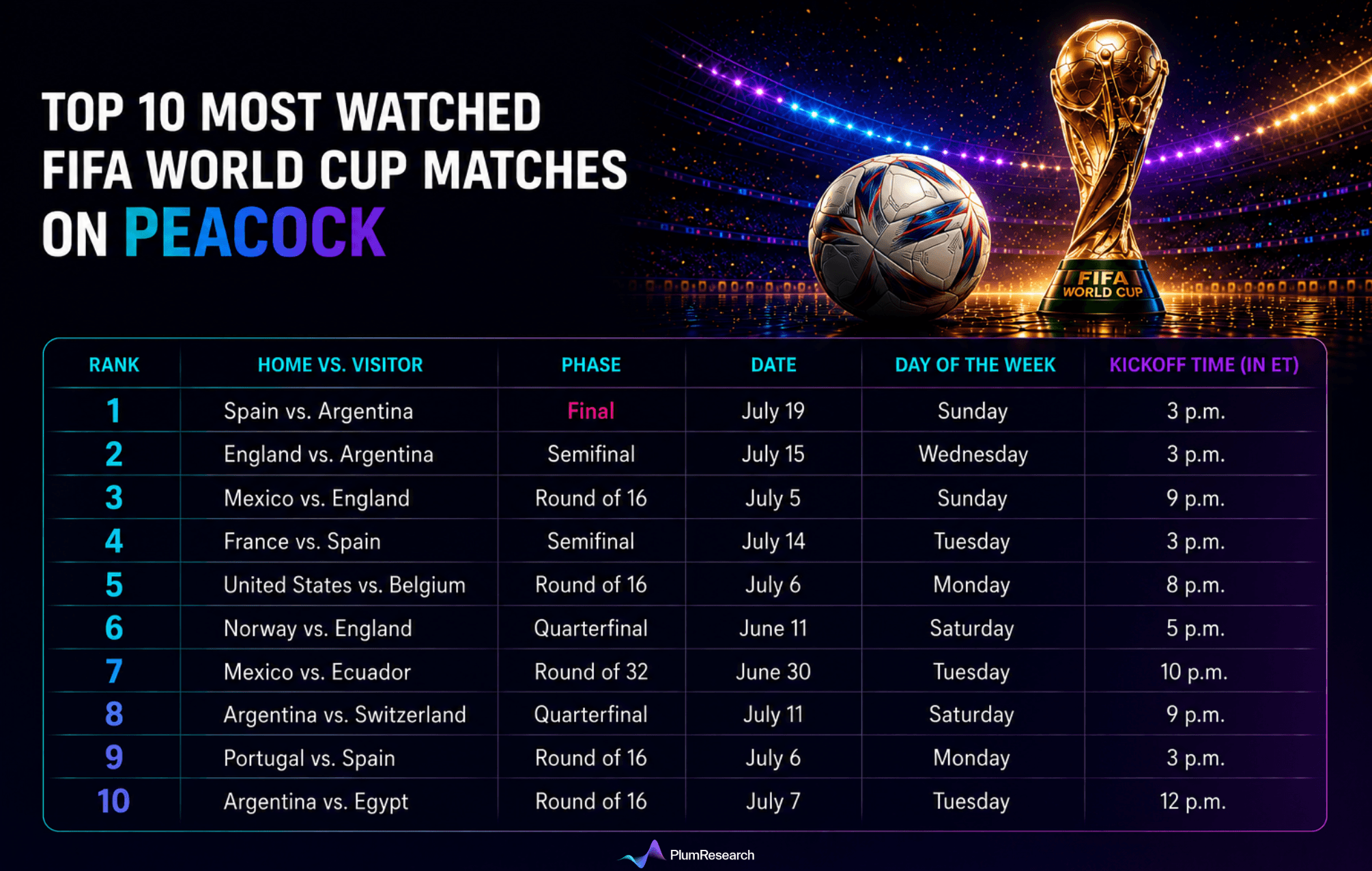
It seems that matches of teams from Spanish-speaking countries were most popular, but football fans were keen to see matches of national teams with the biggest media exposure during the World Cup like Norway or France. But the World Cup also consists of matches between national teams, especially in the group stage. Let’s see how viewership ratings differed at that stage by the day of the week.
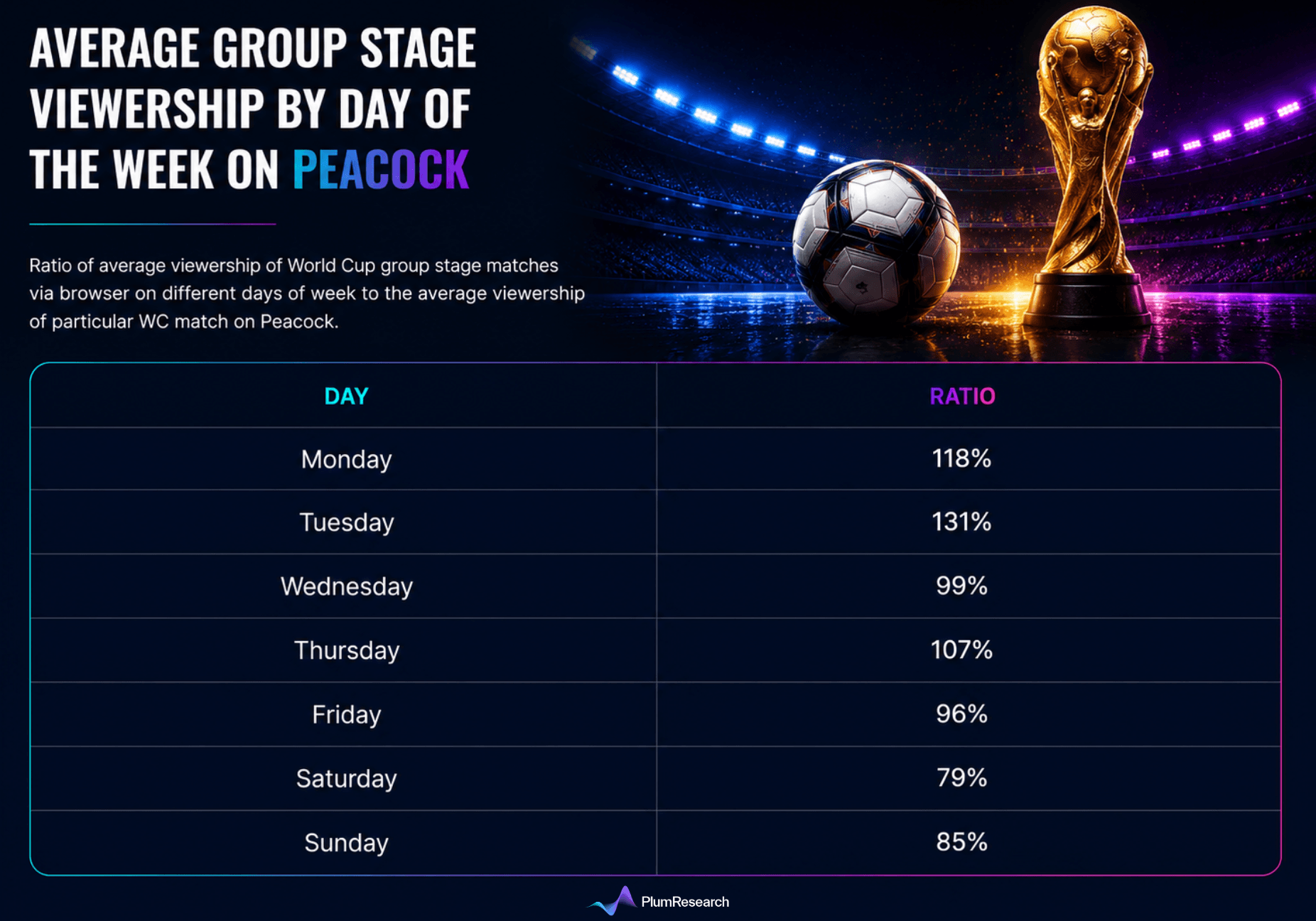
Even if we take into consideration that some national teams were treated by Telemundo viewers as their home teams, such as Mexico and the United States, played on Wednesday, Thursday and Friday, the difference between the average viewership on weekends and the rest of the week is distinguishable. It can also be explained by users’ habits. It is more common to use home or company’s PC/laptop to watch content than on smart TVs or other devices.
To get some further insights into the users’ habits, it is worth checking their preferences by the kick-off time. All times shown below are in ET.
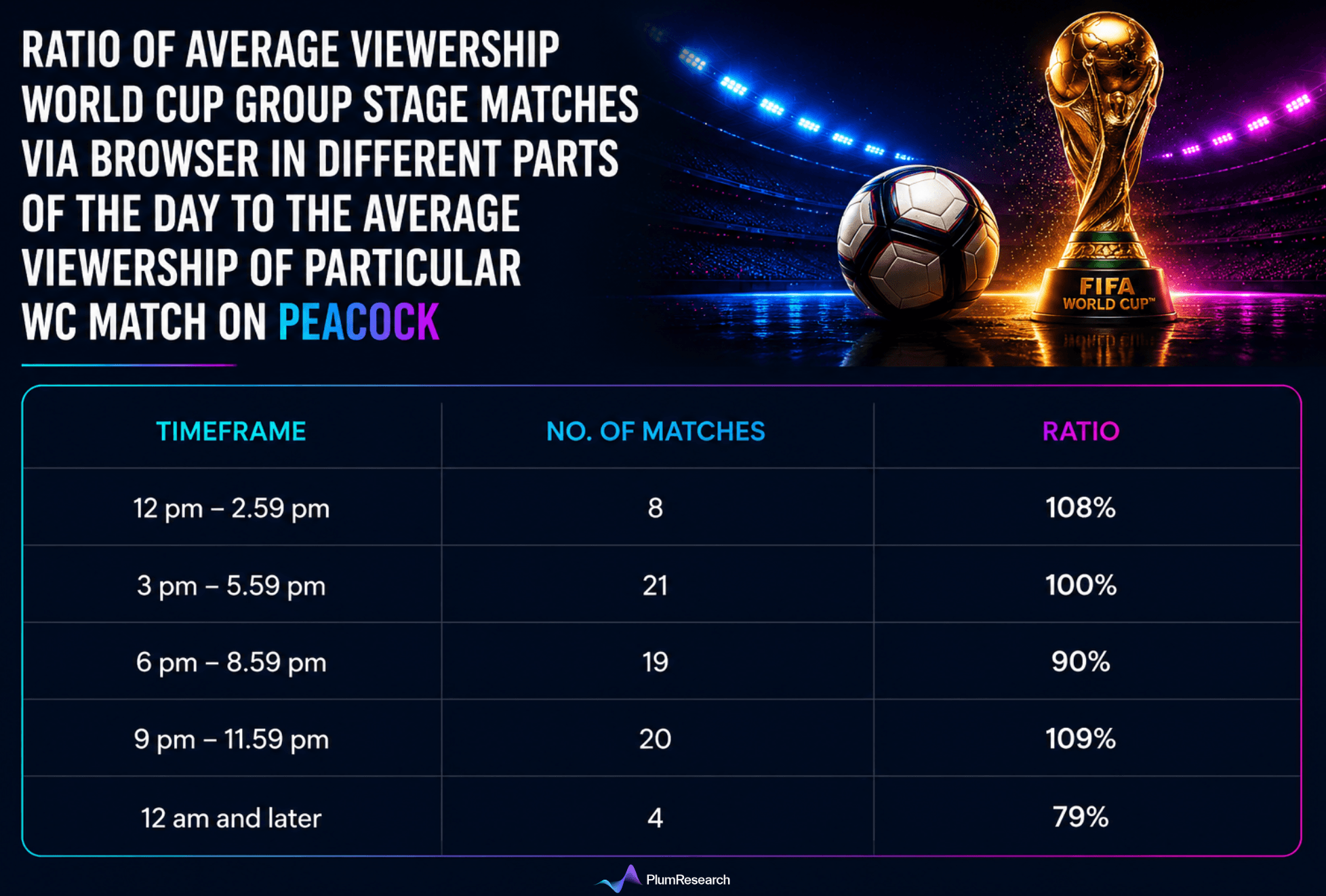
Outside of the ‘graveyard’ post 12 am slot, group stage matches with kick-off time between 6 pm and 8.59 pm, and also had lower viewership among Telemundo viewers watching the World Cup coverage on the Peacock browser version. Mexico and USMNT matches started outside of this slot, which can be one of the reasons, but this time period is also known for the bigger usage of TV sets than the rest of the day.
Watching match broadcasts via browser might be tempting during the third fixture of the group stage where matches in each group are played simultaneously. As it was previously mentioned, FIFA decided to keep groups with four teams to reduce match-fixing and sustain the drama till the last minute. However, some teams could benefit mutually from some results and some were certain of their position in the group before the last game (which was caused by the recent change in regulations made by FIFA to promote head-to-head results rather than the goal difference). Having a second screen is necessary to experience this mayhem fully, so a PC/laptop with a browser suits perfectly. Below you can find the percentage ratio of viewership between third fixture matches within the same group. Bolded are teams which were certain of their exact group position before the match - first or last in the group. Teams in _italics_ are those ones certain (or with a 99.9% probability) of advancing to the Round of 32, but their place would have been settled in the last fixture.
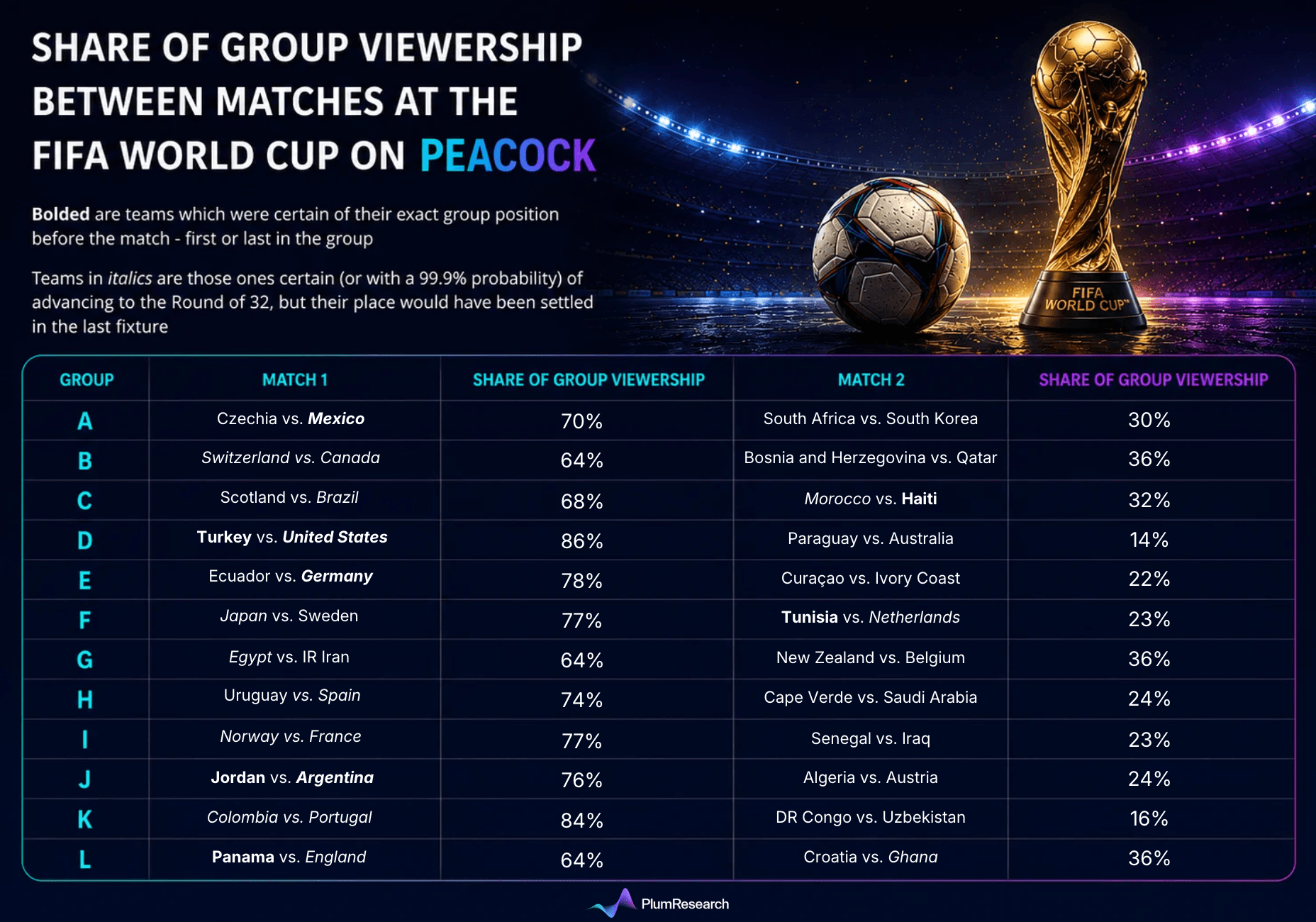
Viewers tend to watch match-ups with the more renowned teams, even if their matches don’t have any significant impact on the further stages of the tournament or when the teams decide to use this opportunity to rest their routine starters. It might be useful for other competition organizers to provide as many games of giants as possible rather than keeping the tournament format to maximize unpredictability till the last game.
The best example of this loyalty of the viewers to their teams is the US match against Turkey. USMNT was certain of finishing the group at the first place, meanwhile Turkey had no chances to achieve a better place than the last one. Americans used many substitutes, but even if the match had no significance for the competition, it was the most watched game from the whole third fixture.
If matches of home teams (Mexico and the United States) are so popular, can they have some ‘halo effect’ for group stage matches before and after them? Let’s find out with the comparison to the average viewership of all group stage matches:
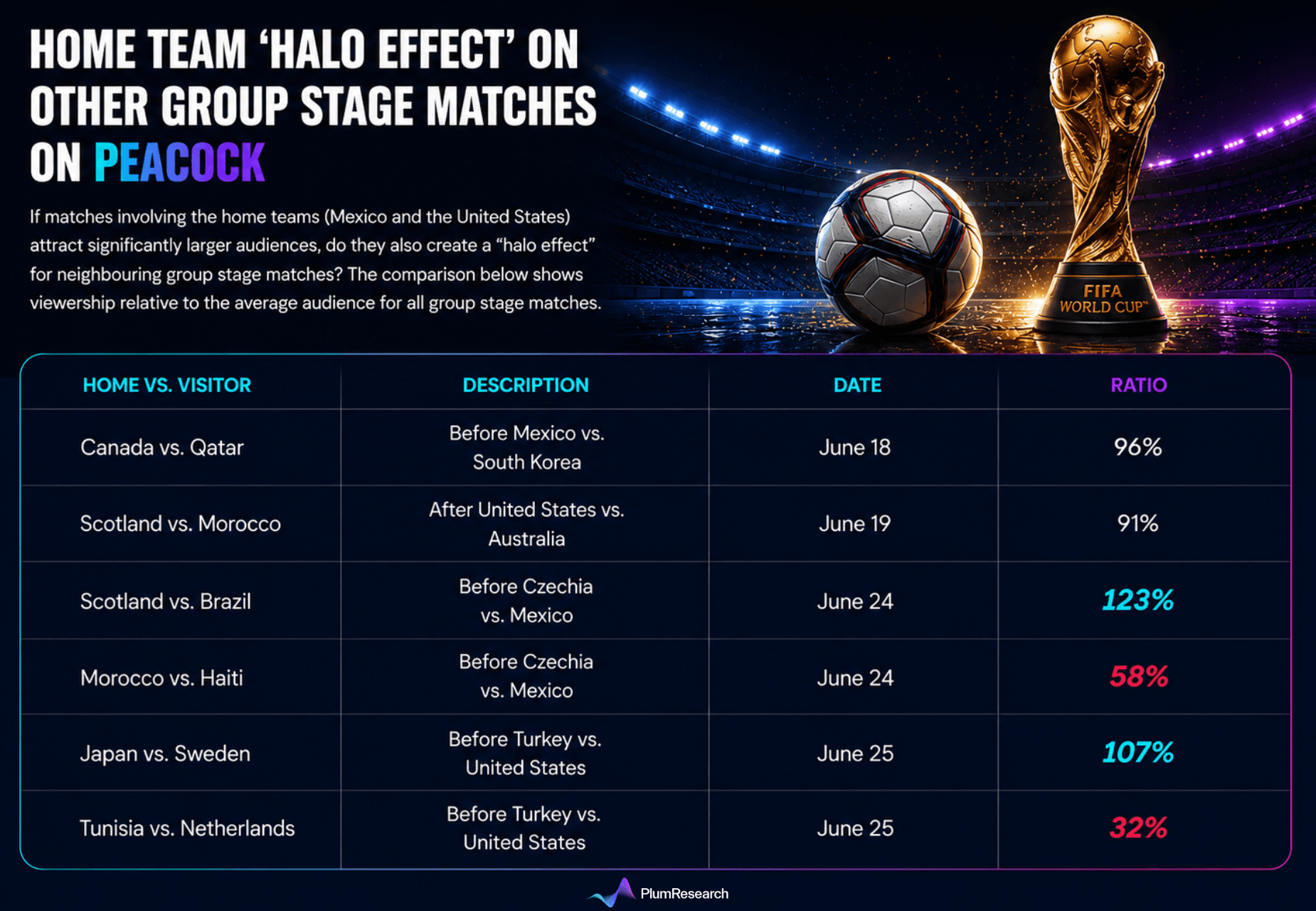
Except for less popular matches of the third fixture (which has fragmented the base of potential viewers), matches played directly before or after US and Mexico games did not have any significant change in viewership compared to other matches in the tournament. Fans who mainly watch national team games usually do not try to watch other matches played directly before or after the one with their home team.
However, there were not so many viewers interested only in matches of their national team. According to our data 5.7% of users watched only USMNT matches and 6.97% were focused only on Mexico ones. The rest of the audience have also watched different games.
As it was mentioned, one of the incentive to pick the Telemundo coverage of Peacock was the fact that some matches were not available on FOX affiliates - 32 out of 72 games were broadcasted on FS1. 9% of all viewers of World Cup in the browser version of Peacock watched only these games, which might indicate that they treated Spanish-speaking coverage to see matches not seen for viewers with terrestrial antenna. Below you can find TOP5 matches on browser version of Peacock, which in the English-speaking commentary were shown only on FS1:
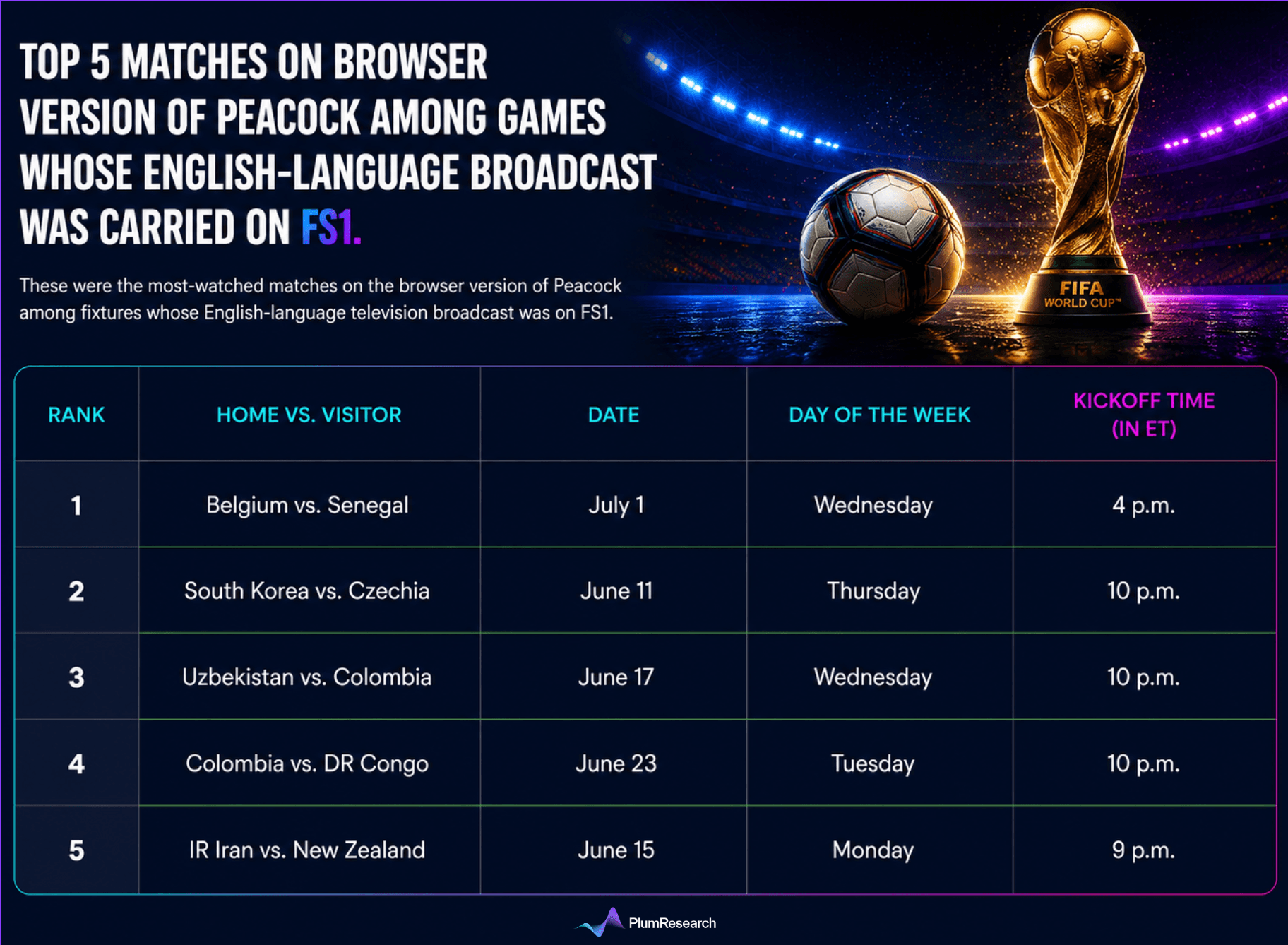
Viewers were most interested in matches which had a direct impact on the fate of their favorite national teams. The winner of Belgium vs. Senegal played against the United States in the Round of 16. South Korea and Czechia were the next opponents of Mexico in the group stage.
It might happen that NBCUniversal would decide in the future about the distribution of the World Cup broadcasts between networks. It is still unknown which media outlet would be responsible for broadcasting the next edition of the men’s competition in 2030, both in English and Spanish. Almost all major players in the market announced bidding for these packages, including NBCUniversal, which would like to get both of them.
But how having Spanish-speaking rights to the World Cup impacted the popularity of non-sports content on Peacock? Among users, who watched the World Cup coverage on the browser version on Peacock, in comparison to the average viewing time in recent two months they have watched 20% more non-sports content during the World Cup, reaching almost three and half hours weekly per viewer.
What distinguishes World Cup viewers from average Peacock users in the area of favorite genres?
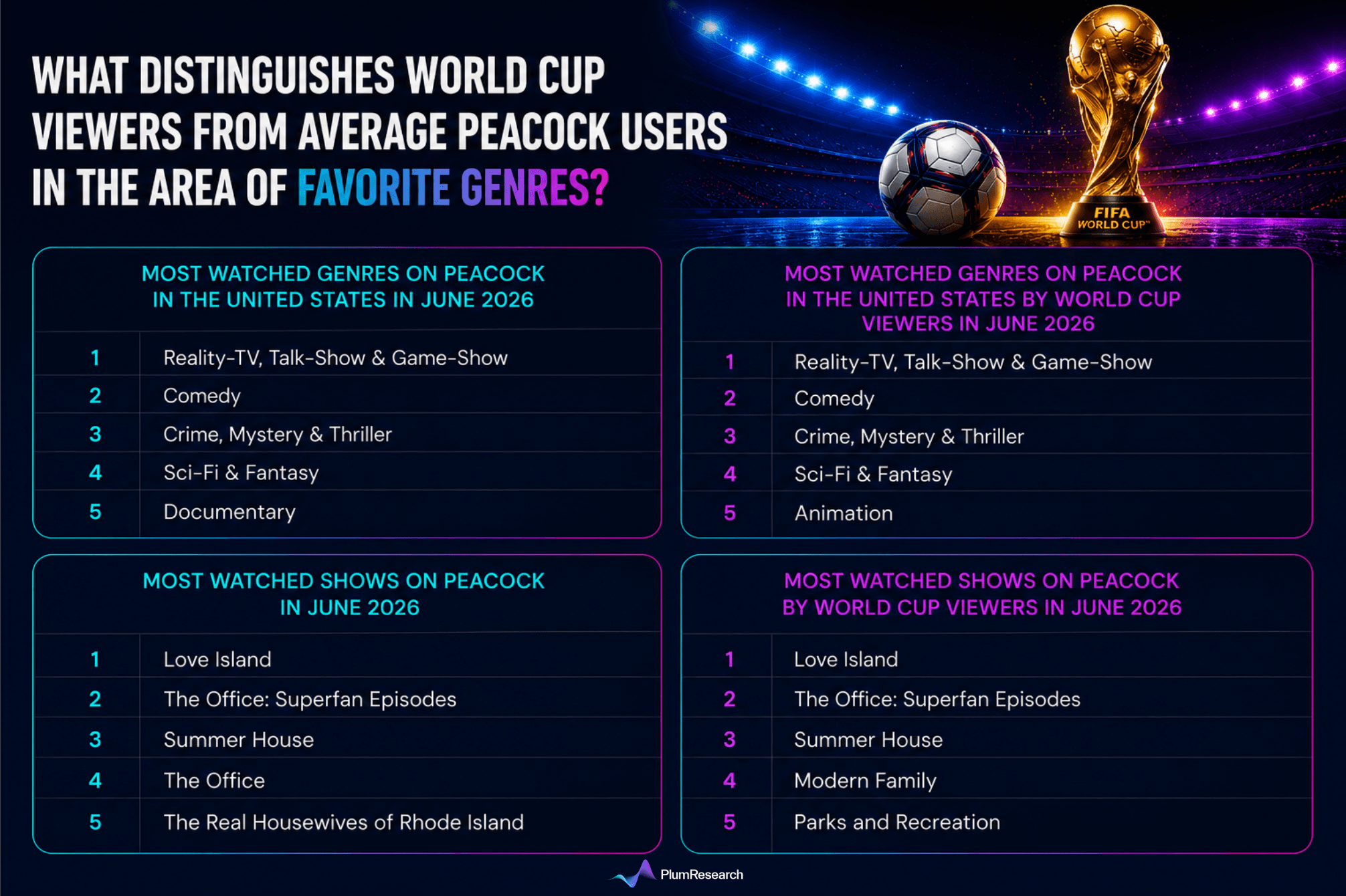
World Cup fans' viewing tastes are very similar to the overall population of Peacock users, which shows that huge sports events like the World Cup attract society as a whole. That is why bidding for broadcasting rights is so important for all major media conglomerates, especially streaming platforms. The extended format of the tournament makes them necessary for people wanting to follow the whole competition. As this report shows, even matches without any stakes have their loyal fanbase, bigger than in the vast majority of sports competition. It seems that America is starting to discover the magic of the World Cup, no matter if with English- or Spanish-speaking commentary.
Even after the World Cup, Peacock will manage to engage football/soccer fans. Before the final match, NBCUniversal announced that its Spanish-speaking outlets will show all UEFA men’s club competitions (Champions League, Europa League, Conference League and Super Cup) starting from the 2027-28 season. The deal will last through the 2029-30 season. Europe might still be the centre of football/soccer activity, but its viewing base extends across the Atlantic Ocean.