

Case Study: Eurovision Song Contest - Europe's biggest guilty pleasure? (May 2026)
Eurovision: More Than a Song Contest

No other TV programme outside sports broadcasts has managed to engage Europeans in the same way as the Eurovision Song Contest. For 70 years, the song competition has been one of the most watched broadcasts in the European public media. Eurovision is the most known event organized by the European Broadcasting Union (EBU), an organization associated with public media organizations from the continent and Northern Africa.
Eurovision is one of the few occasions when European stations decided to show content branded by the EBU. In the second half of the twentieth century, common broadcasts in Western Europe and the UK television were present each weekend. What can be surprising is that the Eurovision Song Contest is popular among a younger audience (15-24 year olds), which is not eager to watch traditional linear television or use public media services. The show has managed to do that thanks to its inclusivity, vast availability on social media like YouTube or TikTok, and providing a communal experience on an international scale.
This case study will focus on assessing the impact of the Eurovision Song Contest shows between 2022 and 2025 on the total viewership of streaming platforms in European countries and Australia. As part of this analysis, we are going to compare the popularity of these services during the semifinals and final of the contest with the yearly average traffic on the platform in each researched country. Additionally, statistics for the most popular Eurovision-themed movie, Eurovision Song Contest: The Story of Fire Saga, will be provided.
Below, you can find the overall traffic on platforms per country (European markets + Australia) during the first semifinal, second semifinal and final in comparison to the yearly average traffic during the same hours on a usual Tuesday, Thursday and Saturday. Values are presented as a percentage change. Highlighted values refer to the shows, in which the country’s representatives have participated:
Percentage change in total viewership on streaming platforms during the Eurovision shows in comparison to usual traffic at that time in 2022:
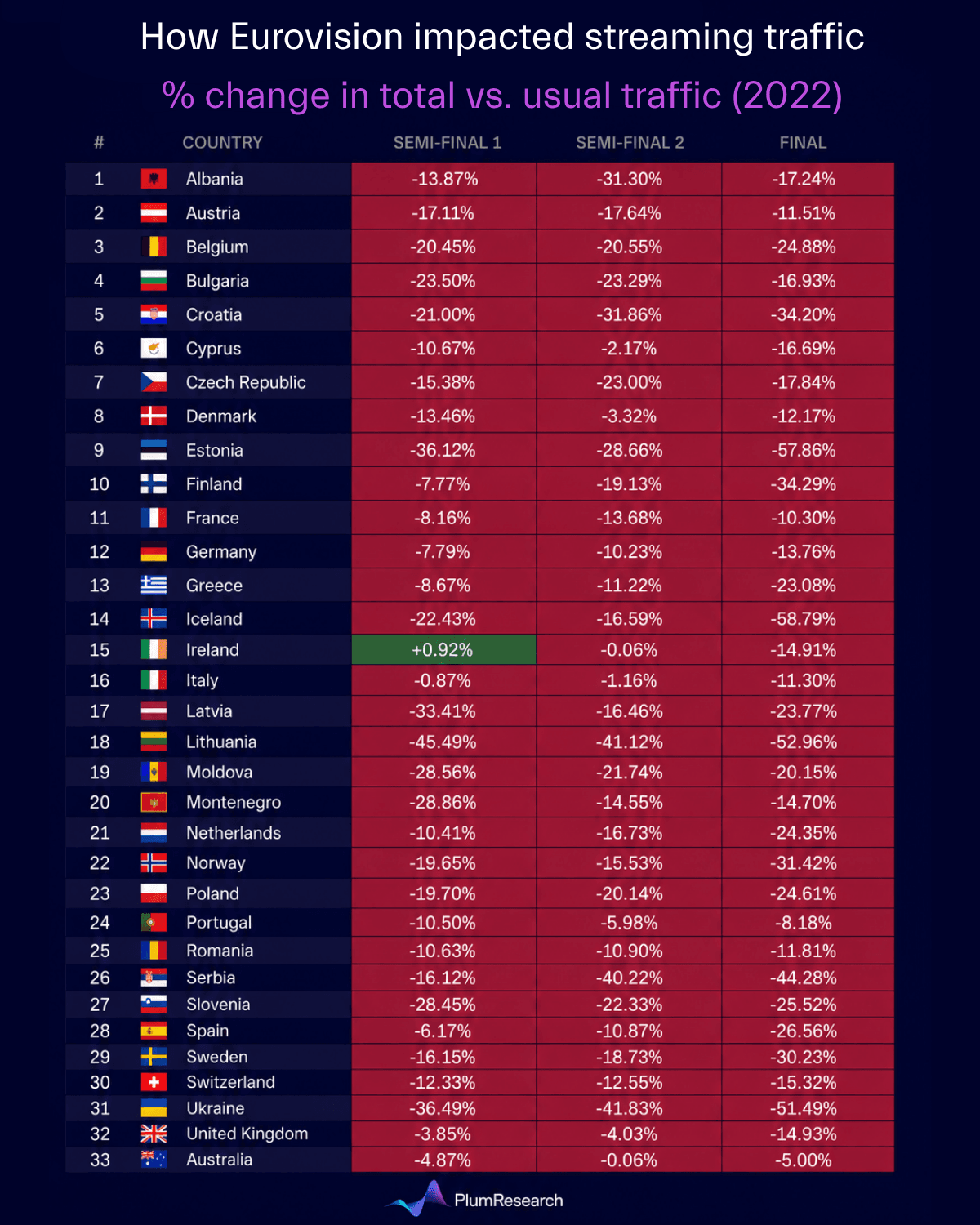
In 2022, viewership in all analysed markets declined during the final, even in countries that did not participate.. Higher engagement could be observed in the case of smaller markets, which are more passionate about the contest. It was also visible in Ukraine, which was at the beginning of the full-scale invasion from Russia, when all activities bonding the nation and showing national pride were popular, especially as Ukraine was perceived as one of the favorites to win the competition. On the European (and Australian) scale, a country's participation in the semi-final influenced overall interest in the event and affected the popularity of other sources of entertainment, such as streaming platforms.
Percentage change in total viewership on streaming platforms during the Eurovision shows in comparison to usual traffic at that time in 2023:
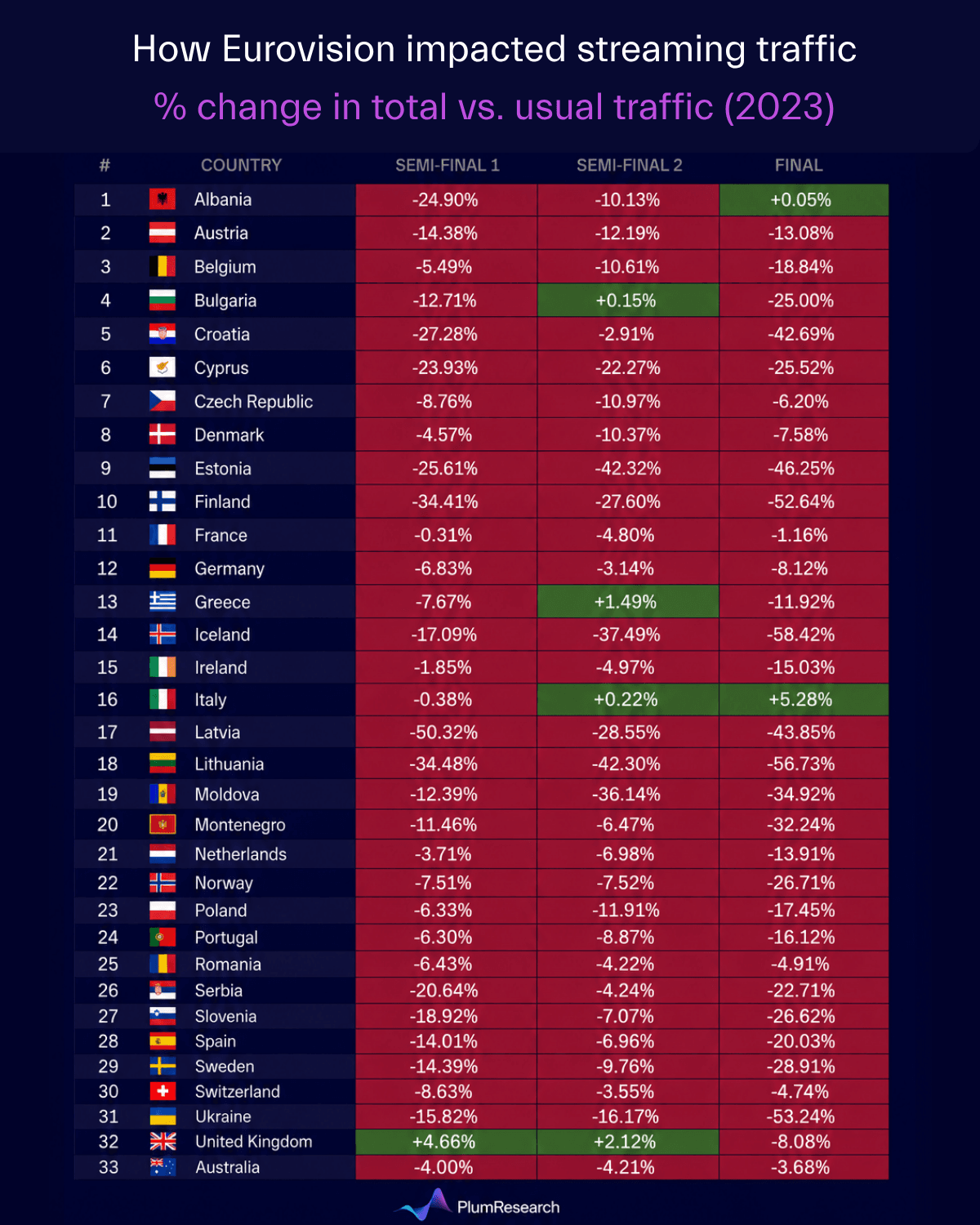
Once again, the perception of being a favourite has impacted the popularity of the show, as was the case with Finland. The contest was organized in Liverpool, but its basis was largely Ukraine-based with many national elements, resulting in greater popularity of the final in Ukraine. The engagement of Icelandic viewers was again remarkable, even though their representative did not advanceto the final.
Percentage change in total viewership on streaming platforms during the Eurovision shows in comparison to usual traffic at that time in 2024:
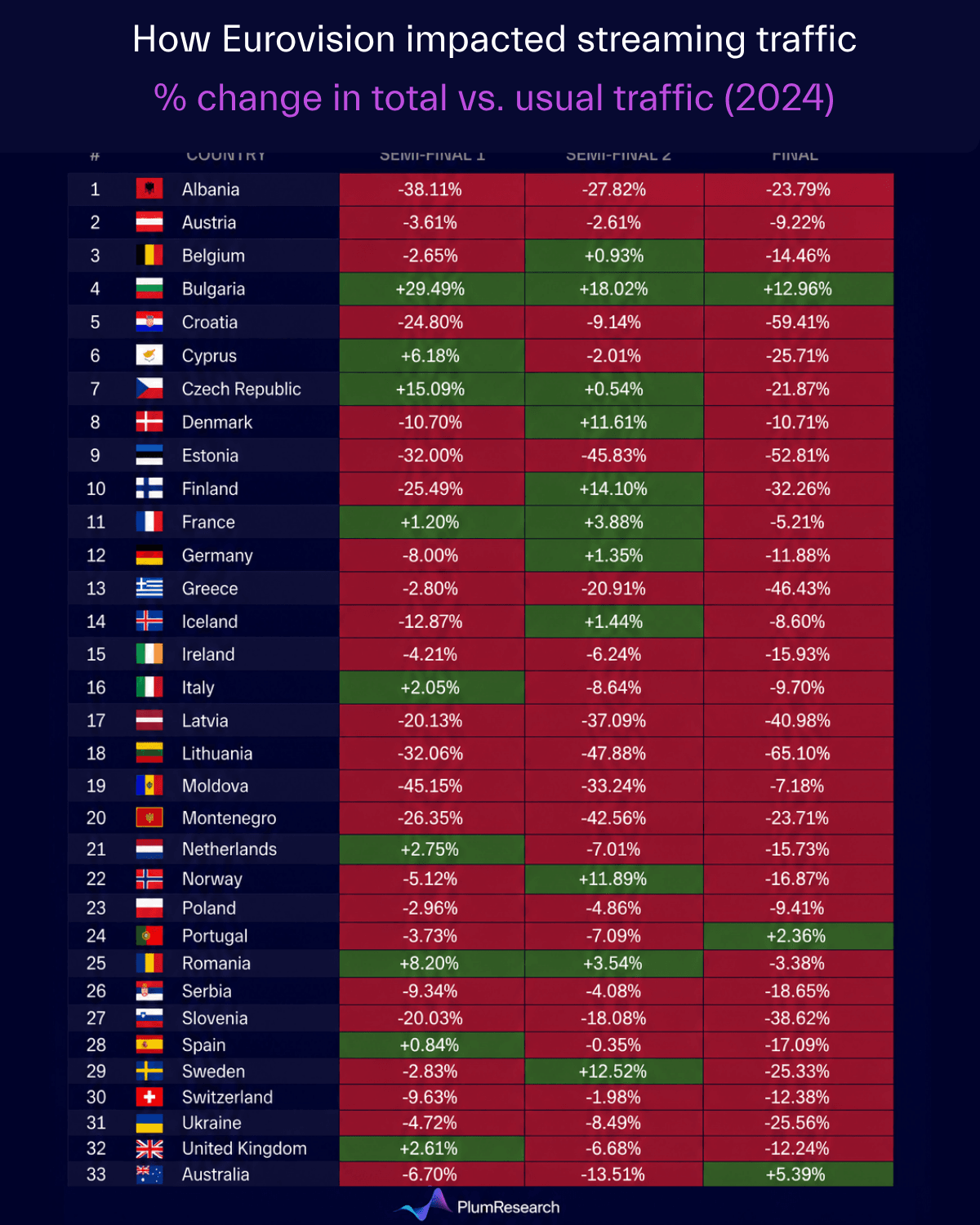
The final show massively affected the Greek media market, where viewership of streaming platforms fell by almost half during the event. The Eurovision Song Contest’s popularity in this country was higher after the introduction of the national qualifiers model. On the other hand, the Australian audience wasn’t so keen to watch the final in comparison to other forms of content, as their representative did not qualify for this stage. Bulgarian television, whose country did not participate in the show, also chose not to broadcast the event, so their citizens didn’t change their viewing habits.
Percentage change in total viewership on streaming platforms during the Eurovision shows in comparison to usual traffic at that time in 2025:
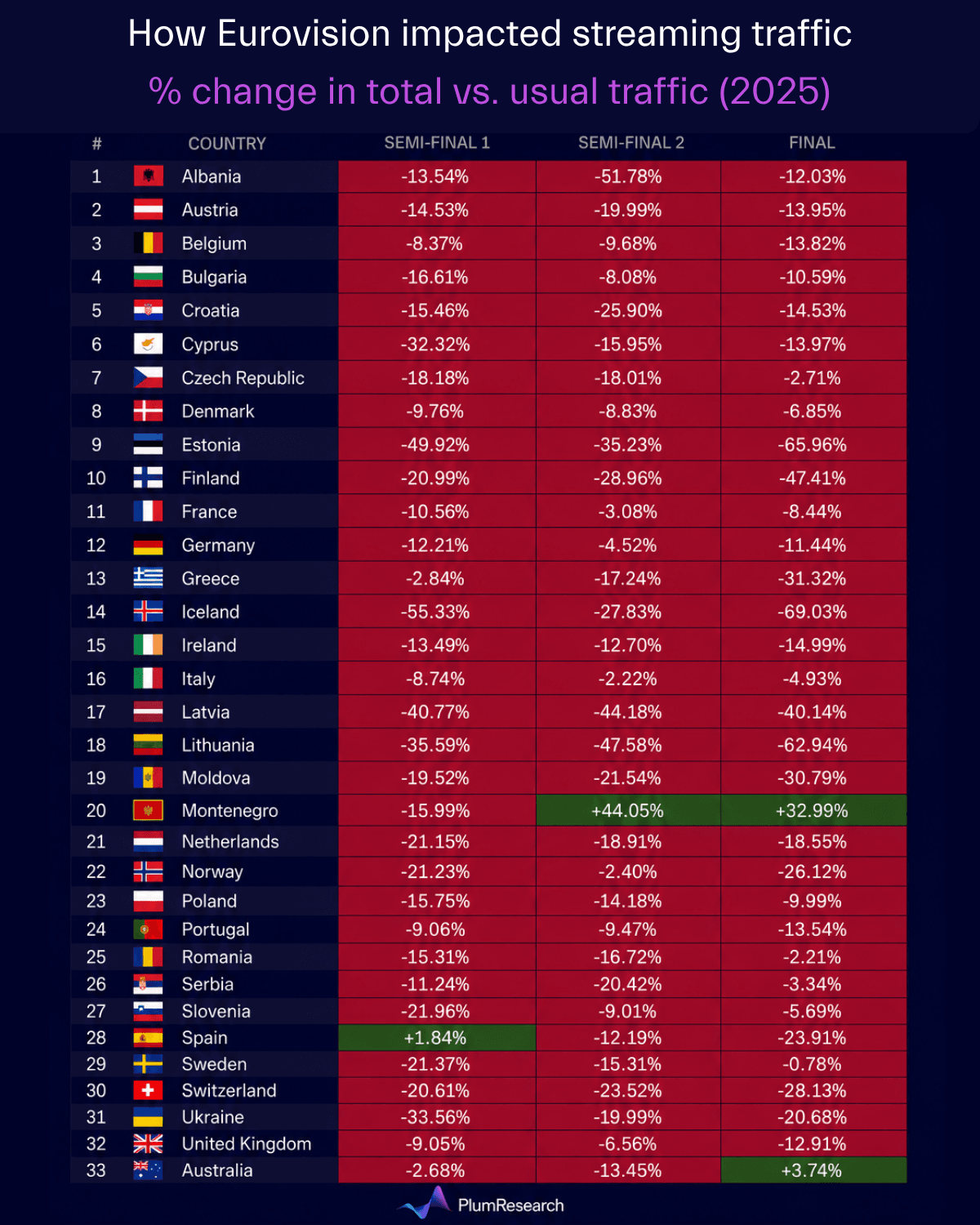
Once again, Australia did not advance to the final, which, without a local representative, wasn’t a huge incentive to watch the contest instead of content on streaming platforms. Montenegrin anomalies can be explained by the controversial national selection process and the exclusion of the winner of the national qualifications. For Swiss audiences, shows organized in their homeland were so popular that they massively impacted their interest in other areas of entertainment during the broadcasts.
As it can be noticed, the Eurovision Song Contest proves to be a strong competitor for audiovisual outlets not broadcasting the show. However,Eurovision-related content is not limited to the public media. In 2020, the comedy movie Eurovision Song Contest: The Story of Fire Saga about a fictional duo preparing for the competition. It was distributed by Netflix and public broadcasters. During the first week after release, it was one of the most watched movies on Netflix in the USA and other European countries. The movies’ main song, "Jaja Ding Dong" went viral within the Eurovision Song Contest community. Let’s check how its monthly viewership changed from January 2021 until April 2026. Highlighted areas include each May, the traditional Eurovision month:
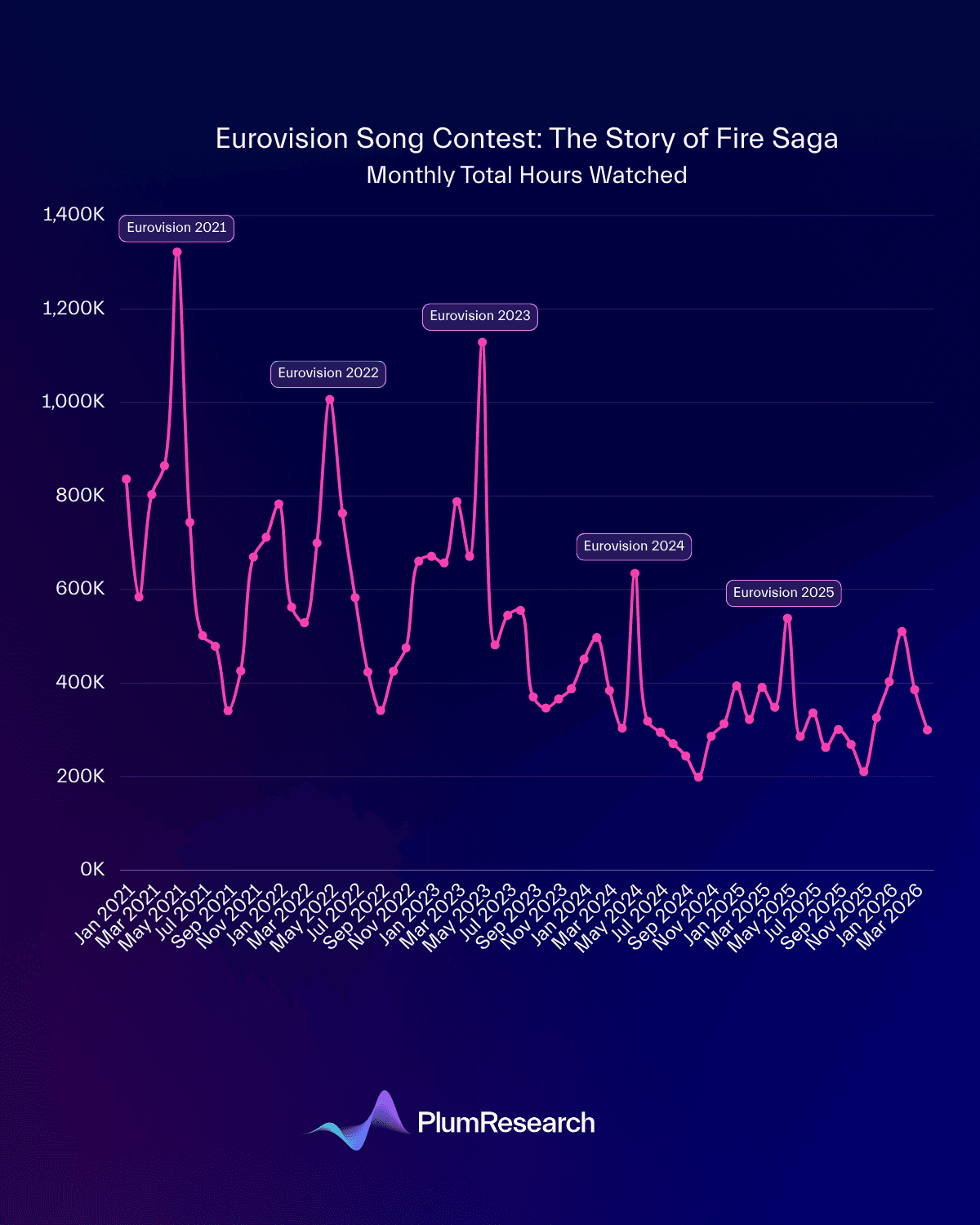
Increased viewership each May fully reflects the rise of interest in the Eurovision Song Contest. And in which countries had the largest audiences of the movie at that time?
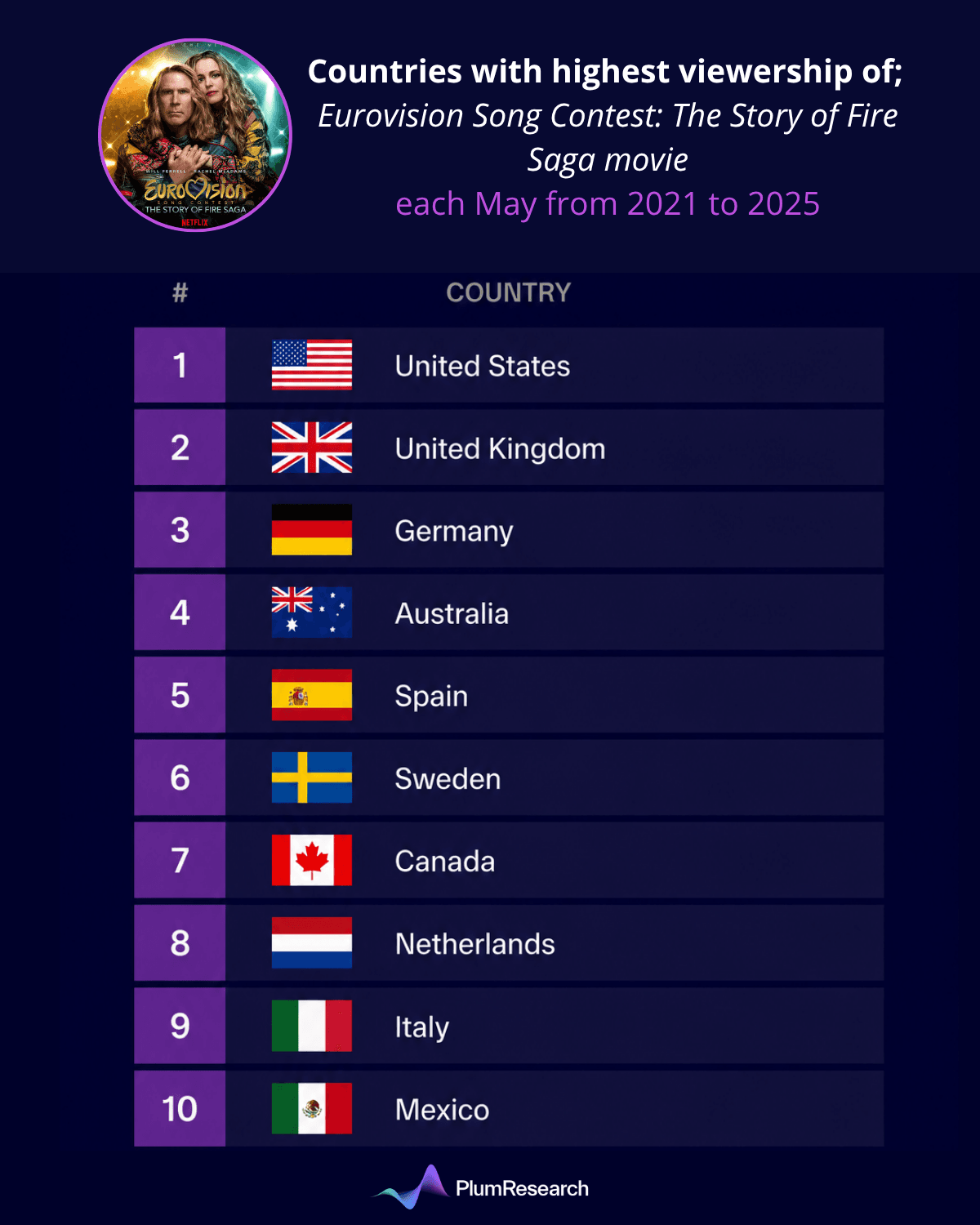
Among traditional European markets and the United States, where the movie was produced, it has fans in other North American countries like Canada and Mexico. These markets could be worth exploring in the European Broadcasting Union actions to reach a bigger audience.
This year’s edition insights may differ from previous ones due to political boycotts from several important countries like Iceland, Ireland, the Netherlands, Slovenia, and Spain. However, the show has repeatedly managed to get through many controversies over its 70-years history and unite multiple generations of Europeans by music.